
A Web Application Firewall (WAF) protects websites and web applications from attacks such as SQL injection, cross-site scripting (XSS), and malicious HTTP requests.
A network firewall controls traffic entering and leaving business networks to prevent unauthorized access. Since they protect different layers, businesses should use both together for stronger, layered security
Businesses use a Web Application Firewall (WAF) to shield them from various types of cyber threats, as well as a traditional network firewall.
A network firewall manages the traffic that goes into and out of a network, while a WAF scans the web requests to detect and prevent malicious activity targeting web applications and websites.
Online businesses have a need to reinforce security and make it better.
In Nepal, companies rely on websites, e-commerce sites, online payment systems, customer portals, and cloud applications to cater to customers.
These platforms provide vulnerabilities for cyber-attacks as well. A weak web application might reveal the customer details and cause disruption for business operations and impact customer confidence.
WAFs and firewalls both serve to protect digital infrastructure, but they each have their own distinct purpose. It is important to know the difference, however, to choose the right security controls to mitigate threats rather than treating all the same.
What Is a Firewall and How Does It Protect a Business Network?
A firewall is a network security system that monitors and regulates network traffic based on pre-established security rules.
It enables connections that are approved and denies access to those that are not, which helps to prevent unauthorized access to business networks and infrastructure.
In a traditional network firewall, rules are typically enforced based on IP addresses, ports, and protocol information.
It is possible to set the rules on a firewall to only let certain outside connections through while keeping others from entering the business.
Firewalls are useful for protecting:
- Business networks and internal systems
- Servers and cloud infrastructure
- Employee devices and office networks
- Remote access connections
- Communication between different network segments
More capabilities exist such as intrusion prevention, application awareness, encrypted traffic inspection and threat intelligence, which can be offered by modern Next-Generation Firewalls (NGFWs).
For instance, a financial services firm in Nepal could implement a network firewall to regulate the traffic for the office network, application servers and external connections. This ensures that the network is not accessed by unauthorized users and that only services that are authorized are communicated with.
DataHub provides Firewall as a Service (FWaaS) through a Next-Generation Virtual Firewall Appliance. Its published service features include intrusion prevention, advanced routing, IPsec tunnels, SSL inspection, threat protection and high-availability or load-balanced configurations.
What Is a Web Application Firewall (WAF)?
Web Application Firewall (WAF) is a type of application protection software that helps guard websites and web applications by observing, filtering and blocking possibly dangerous HTTP and HTTPS requests. It’s centered on application-layer threats that might not be caught by standard network traffic filtering solutions.
In general, a WAF is deployed before the web application and filters incoming requests prior to their arrival at the application server. It applies security rules and policies to detect suspicious request patterns and make decisions on whether to allow, monitor or block traffic.
A WAF can help protect:
- E-commerce websites and online stores
- Banking and financial portals
- Customer login and registration systems
- Business web applications
- APIs used by websites and mobile applications
- Online booking and payment platforms
For example, an e-commerce website may receive a request containing a malicious SQL injection payload. A WAF can inspect the request, identify patterns associated with SQL injection and block it before it reaches the application.
DataHub offers WAF as a Service to monitor and filter web traffic. Its official service page describes positive and negative security model policies, Layer 7 DoS protection and filtering designed to block malicious traffic before it reaches application and data servers.
What Is the Difference Between WAF and Firewall?
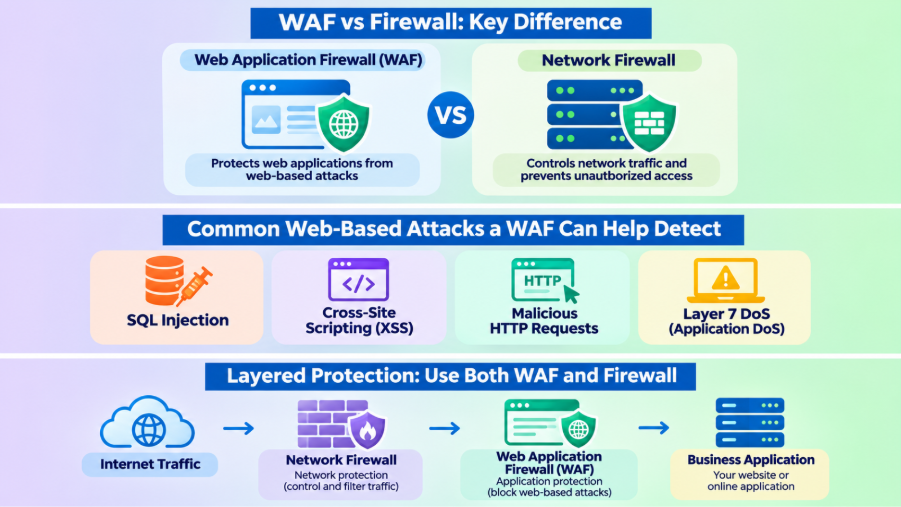
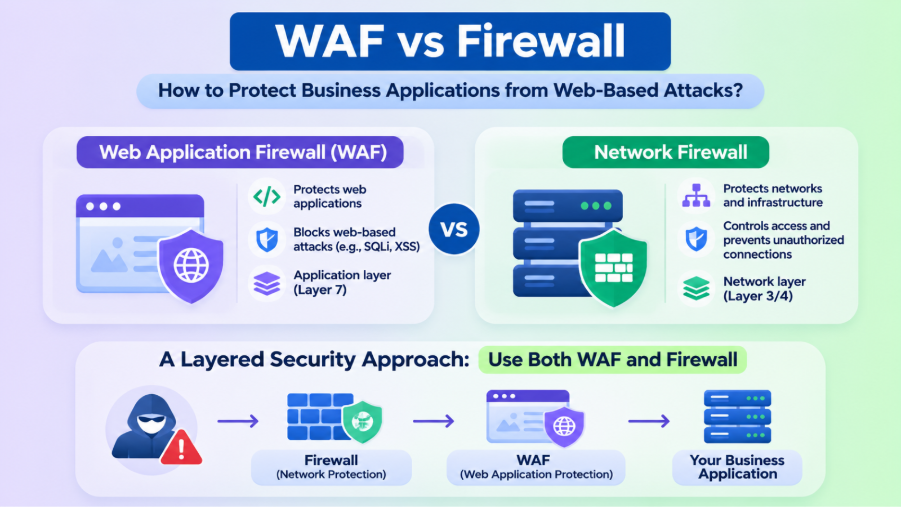
The main difference between WAF and Firewall is the type of traffic they inspect and the systems they protect. A network firewall protects network boundaries and infrastructure, while a WAF focuses on HTTP and HTTPS requests targeting web applications.
| Comparison | Network Firewall | Web Application Firewall (WAF) |
| Primary purpose | Protects networks and infrastructure | Protects websites and web applications |
| Main traffic focus | Network traffic | HTTP and HTTPS requests |
| Security focus | Unauthorized network access and suspicious connections | Malicious web requests and application-layer attacks |
| Common inspection criteria | IP addresses, ports, protocols and connection rules | Request content, headers, URLs, parameters and application traffic patterns |
| Typical protection | Network access control and intrusion prevention | SQL injection, XSS and other web-based attacks |
| Deployment | Network gateway, appliance, virtual firewall or cloud service | In front of a web application, on-premises or through a cloud service |
| Main use case | Protecting servers, networks and internal systems | Protecting public-facing websites, APIs and web applications |
While a network firewall can stop unauthorized access to a server, it can’t detect all attempts to tamper with any other legal access to the web. To assist in identifying these threats, a WAF includes application-specific inspection.
Note that some NGFW products provide application-layer inspection. But there is a WAF specifically built for the inspection and protection of the web application traffic.
What are Types of Web-based Attacks?
By analyzing incoming web requests, a WAF can detect and stop typical application-layer attacks. The effectiveness of its use relies on the security rules, security configuration, application architecture and its maintenance.
Some common threats include:
1. SQL Injection
Here, SQL injection happens when an attacker adds malicious SQL statements to application inputs in order to get the database to run different SQL statements than intended.
For instance, an attacker could exploit a site’s login or search feature to gain unauthorized access to information.
A WAF can scan incoming requests for any suspicious SQL patterns and prevent requests from hitting the database if they are flagged as security violations by the security rules configured in the WAF. But businesses should also employ secure coding and parameterized database queries.
2. Cross-Site Scripting (XSS)
Cross-Site Scripting (XSS) is a security flaw in which an attacker embeds malicious code that can run in a user’s browser when he visits a vulnerable website.
These scripts can be used to steal session information, change content or do something else.
A WAF can detect and block any suspicious script in incoming requests. Input validation and output encoding are also important to be applied to prevent XSS vulnerabilities in application development.
3. Denial-of-Service (DoS) Attacks
Denial of Service (DoS) attack is a type of attack that floods a website or application with such requests or other resource-intensive operations that it becomes unavailable.
Certain WAFs include DoS protection on Layer 7 which can assist in the detection and regulation of any abnormal application traffic. But do not assume a WAF is infallible against all types of distributed denial of service (DDoS) attacks.
Capacity, rate limiting, upstream DDoS protection, and infrastructure resilience are among the aspects businesses should consider when planning for security.
4. Malicious HTTP Requests
Specialized HTTP requests can be sent to take advantage of application vulnerabilities, gain access to protected information or cause abnormal application action.
A WAF can analyze the request patterns and then impose security policies to stop the suspicious traffic from reaching the application.
In this session, students will learn the basics of file inclusion and other attacks at the application layer.
The file inclusion vulnerability can be used to enable attackers to make an application load unauthorized files or resources. This can reveal sensitive information or further compromise the system depending on the application and attack.
Should Businesses Use Both WAF and Firewall?
Yes. Businesses operating public-facing websites, online portals or web applications should consider using both network firewall protection and WAF security. They provide different layers of protection and are more effective when configured to work together.
Consider an online business with a public website, an application server and an internal database.
- Network Firewall: Controls which systems and network connections can communicate with the application server and database.
- WAF: Inspects incoming web requests and blocks suspicious application-layer traffic.
- Application Security: Uses secure coding, authentication, access controls and regular updates to address vulnerabilities within the software.
This multi-layered approach minimises reliance on a single security product.
How Can Nepali Businesses Choose the Right WAF and Firewall Solution?
Nepal’s businesses need to choose security solutions according to their application exposure, infrastructure, data sensitivity, traffic volume and technical requirements.
The right solution will depend on the threats they need to solve, and the resources that are available to handle security.
Here are a few things that you should take into account when selecting a provider:
1. Identify What Needs Protection
Determine the systems that are connected to the Internet. Multiple security controls may be needed for a public-facing website, customer portal, payment application and internal business network.
For a business with an Internet store, protection of the website with WAF is recommended and protection of the network firewall as well as internal systems with server protection is recommended.
2. Check Security Features
Do not select a solution based only on the terms WAF or Firewall. Review the actual capabilities included in the service.
For a WAF, consider:
- HTTP and HTTPS traffic inspection
- SQL injection and XSS protection
- Security rule management
- Malicious request filtering
- Layer 7 DoS protection
- Logging, monitoring and reporting
For a network firewall, consider:
- IP, port and protocol filtering
- Intrusion prevention
- Network segmentation
- VPN and IPsec support
- SSL inspection
- High availability and traffic management
The availability of each feature depends on the provider and service configuration.
3. Evaluate Performance and Scalability
Security tools should not adversely impact application performance.
Find out from providers how they would respond to changes in traffic, rules, high traffic and app changes. Security configurations can also be put to the test to see if any false positives are raised that may interfere with valid users.
4. Review Management and Technical Support
Security solution must be monitored, policies and configurations must be reviewed regularly. Managed security services can benefit businesses if they do not have their own security team.
See if the provider can help with initial setup, security rule configuration, monitoring, handling incidents, and ongoing maintenance. Explain the support hours and response time.
5. Compare Local Service Providers
Nepal has several providers offering network security, firewall management, and cloud security services.
Among them, DataHub Nepal stands out with its dual data centre infrastructure in Kathmandu and Butwal, providing locally hosted cloud solutions within Nepal. providing locally hosted cloud solutions within Nepal.
Its combination of local data hosting, cloud infrastructure, and enterprise-focused services makes it a strong option for businesses seeking greater control over their data and IT infrastructure.
Conclusion
A network firewall regulates the traffic going to and from networks and safeguards the infrastructure from unauthenticated access, while a WAF analyzes the web requests to avoid application-layer attacks like SQL injection and cross-site scripting.
If your company in Nepal has websites, an e-commerce platform or portals, customer portals or web applications, depending on just one of these application control options can result in serious holes.
Using a combination of security WAF, network firewall rules, developing applications safely, and monitoring enables you to create a more comprehensive security approach.
Data Hub offers Firewall as a Service and WAF as a Service for organizations that require web application and network protection.
Go over the list of features available and tell us your infrastructure needs to decide which configuration is best for your application.
Frequently Asked Questions
1. Is a WAF the same as a firewall?
No. A WAF is designed to protect web applications by inspecting HTTP and HTTPS requests. A traditional network firewall controls traffic entering and leaving networks based on security rules such as IP addresses, ports, and protocols.
2. Can a WAF replace a network firewall?
No. A WAF focuses on application-layer traffic and does not provide the full network access control offered by a network firewall. Businesses with public-facing applications generally benefit from using both.
3. Does a WAF protect against SQL injection and XSS?
A properly configured WAF can help detect and block requests associated with SQL injection and cross-site scripting. However, it should complement secure coding, input validation, output encoding, and regular application security testing.
4. Do small businesses in Nepal need a WAF?
A small business may benefit from a WAF if it operates a public-facing website, online store, customer portal, or web application. The need depends on the application’s exposure, the information it handles, and its potential business impact if compromised.
5. What is the difference between WAF as a Service and Firewall as a Service?
WAF as a Service provides managed protection for web applications by inspecting and filtering HTTP and HTTPS requests. Firewall as a Service delivers network firewall capabilities through a cloud-based or virtual service to control network traffic and protect infrastructure. Both can be used together for layered security.