
Choosing between Public Cloud, Private Cloud, and Virtual Private Cloud in Nepal depends on your business requirements, budget, security expectations, and plans for growth.
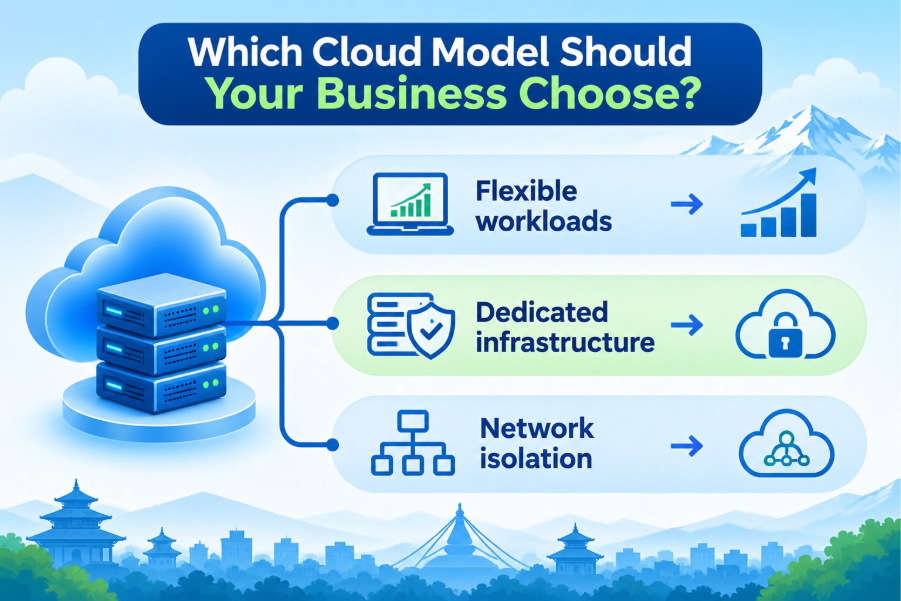
Public Cloud is suitable for flexible and scalable workloads, Private Cloud offers dedicated infrastructure, and VPC provides an isolated virtual network environment.
Understanding their differences helps businesses select the right cloud infrastructure without paying for unnecessary resources.
As more Nepali businesses move applications, databases, and business operations online, choosing the right cloud environment has become an important technology decision.
Banks, financial institutions, e-commerce companies, software businesses, and growing enterprises all have different infrastructure requirements.
However, these cloud options are not interchangeable. Each provides a different level of resource allocation, control, and network isolation.
Businesses should understand what each model offers before selecting a cloud service provider in Nepal.
What Are Public Cloud, Private Cloud and Virtual Private Cloud?
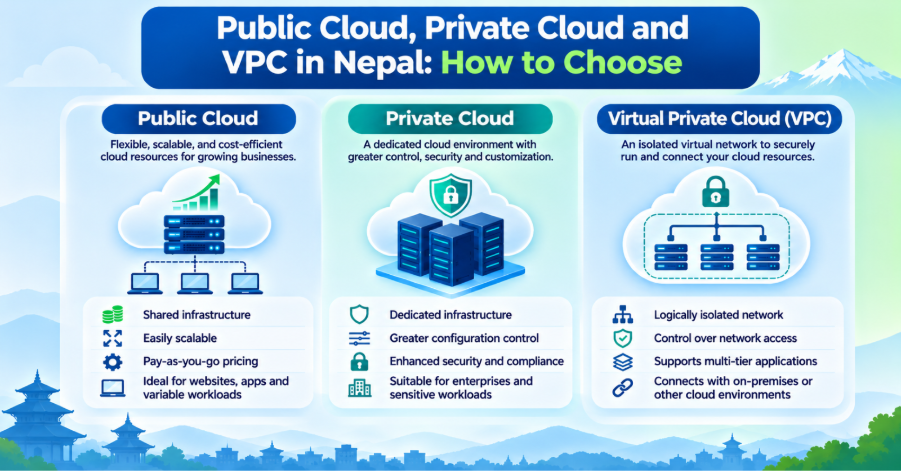
Public Cloud, Private Cloud, and Virtual Private Cloud are cloud infrastructure options that allow businesses to access computing resources without managing every part of the physical infrastructure themselves.
What Is Public Cloud?
A public cloud is a computing model where third-party providers own, manage, and deliver shared IT resources.
Public Cloud provides computing resources through a cloud infrastructure managed by a service provider.
Businesses can rent virtual servers, storage and networking resources based on their requirements instead of purchasing and maintaining physical servers.
A public cloud environment generally uses shared physical infrastructure, while virtual machines and allocated resources remain logically separated between customers.
It is mostly useful for:
- Business websites and web applications
- Software development and testing
- E-commerce platforms
- Startups and growing businesses
- Applications with changing resource requirements
For example, a business can begin with a small virtual server and increase its CPU, RAM or storage as its application grows.
DataHub Nepal provides Public Cloud services with NVMe storage, root access, snapshot backups and scalable server resources. Its published plans allow businesses to start with a small configuration and upgrade when additional capacity is required.
What Is Private Cloud?
Private Cloud is a cloud environment dedicated to a single organization. Unlike a typical public cloud setup, its underlying infrastructure is reserved for one customer rather than shared across multiple organizations.
This arrangement provides greater control over resource allocation, infrastructure configuration and access management.
Private Cloud is suitable for:
- Banks and financial institutions
- Insurance companies
- Large enterprises
- Businesses managing sensitive customer information
Note: Private cloud is not limited to these industries. Any organisation requiring better data security, privacy, and control can use a private cloud.
A private cloud can be hosted within an organization’s own facility or managed by an external cloud provider.
As a service provider, we at DataHub Nepal offer Private Cloud services through dedicated, single-tenant infrastructure. We also offer enterprise-grade hardware, NVMe storage, customization options, monitoring.
What Is Virtual Private Cloud (VPC)?
Virtual Private Cloud (VPC) is a virtual network environment, an isolated space designed in a cloud infrastructure. It provides businesses with the ability to set up private IP addresses, network access controls, routing and communication among cloud resources.
VPC is generally perceived as a public cloud infrastructure, but the architecture and isolation properties rely on the provider’s implementation. Do not automatically assume it is the same as a fully-fledged private cloud.
A VPC is useful for:
- Connecting multiple applications securely
- Separating production and development environments
- Managing access between servers
- Hosting business applications with specific network requirements
- Connecting on-premises infrastructure with cloud resources.
Note: VPCs are not limited to these use cases. They can support any application or business requiring a secure, isolated, and customised cloud network.
Datahub provides Virtual Private Cloud services with network isolation, security controls and high-availability features for enterprise workloads.
What Is the Difference Between Public Cloud, Private Cloud and VPC?
The main difference is how infrastructure resources and network environments are allocated and controlled. Public Cloud offers flexible virtual resources, Private Cloud provides dedicated infrastructure, and VPC creates an isolated network environment for cloud resources.
| Comparison | Public Cloud | Private Cloud | VPC |
| Infrastructure | Generally shared physical infrastructure | Dedicated to one organization | Depends on underlying cloud infrastructure |
| Resource allocation | Virtual resources allocated to customers | Dedicated resources | Configurable virtual resources and networks |
| Network isolation | Logical separation | Private environment | Isolated virtual network |
| Customization | Provider-dependent | Generally extensive | Network and access configuration |
| Scalability | High | Depends on infrastructure capacity | Depends on available cloud resources |
| Cost structure | Often pay-as-you-go or plan-based | Configuration-based | Configuration and resource-based |
| Suitable for | Websites, applications and growing workloads | Sensitive or resource-intensive workloads | Applications requiring network segmentation |
Can a Business Use More Than One Cloud Model?
Yes. Businesses do not always need to choose only one cloud model.
A hybrid approach can combine public cloud resources with private infrastructure or isolated network environments.
For example, a company may run its customer-facing website on Public Cloud while keeping sensitive internal applications in a Private Cloud environment.
This approach allows organizations to match infrastructure choices with the requirements of individual workloads.
How Much Do Cloud Services Cost in Nepal?
Cloud service costs in Nepal depend on the resources required, including CPU, RAM, storage, and the type of infrastructure.
For businesses looking for an affordable starting point, we offer scalable Public Cloud VPS plans with different resource configurations to meet varying hosting and workload requirements.
DataHub Nepal Public Cloud VPS Pricing
DataHub Nepal offers the following monthly Public Cloud VPS plans:
| Plan | Monthly Price | CPU | RAM | Storage |
| Small | NPR 1,000 | 1 vCore | 1 GB | 10 GB NVMe |
| Medium | NPR 2,100 | 2 vCores | 2 GB | 25 GB NVMe |
| Large | NPR 3,000 | 2 vCores | 4 GB | 50 GB NVMe |
These plans allow businesses to choose cloud resources based on their current workload and budget.
The Small plan provides an entry-level option for basic hosting needs, while the Medium and Large plans offer additional memory and storage for growing applications and workloads.
Businesses can also scale their cloud resources as their requirements increase, helping them manage infrastructure without investing in physical servers.
For organisations with more specific infrastructure, security, or networking requirements, we at datahub Nepal also offer Private Cloud and Virtual Private Cloud (VPC) solutions.
These solutions can be customised based on business needs, resource requirements, and infrastructure preferences.
Pricing for these services depends on the required configuration and is available through a customised quotation.
How Should Individuals and Businesses Choose Public Cloud, Private Cloud, or VPC?
The right cloud infrastructure depends on how individuals and businesses use technology, manage data, and plan for growth.
1. How Should You Choose Public Cloud?
For individuals, startups, and businesses seeking flexible, scalable, and cost-effective computing options, Public Cloud is an effective solution.
You should consider Public Cloud if you:
- Need low-cost hosting: begin with smaller resource plans without having to purchase physical servers or dedicated infrastructure.
- Host personal websites or applications: Host blogs, portfolios, websites, and small applications without owning any physical hardware.
- Use the computer to run your own start-up or small business: Use computing resources as needed and expand, according to the growth of your business.
- Switch between loads: Add or remove CPUs, RAM, and storage depending on the needs of the applications.
- Need development and testing environments: Set up virtual servers for software development, testing and deployment.
2. How Should You Choose Private Cloud?
Private Cloud is suitable for businesses and organizations that require dedicated infrastructure, greater control, and customized computing environments.
You should consider Private Cloud if you:
- Handle sensitive business information: Manage confidential customer, financial, or organizational data in a dedicated infrastructure environment.
- Require dedicated resources: Access infrastructure reserved for your organization rather than sharing the underlying infrastructure with other customers.
- Need greater customization: Configure infrastructure according to specific business applications, workloads, and operational requirements.
- Operate critical business applications: Support enterprise systems, databases, and resource-intensive workloads that require dedicated infrastructure.
- Have specific infrastructure requirements: Choose a cloud environment that can be configured around your organization’s security, resource allocation, and management needs.
3. How Should You Choose Virtual Private Cloud (VPC)?
Virtual Private Cloud is a suitable option for individuals, developers, and businesses that need an isolated and customizable network environment within a cloud infrastructure.
You should consider VPC if you:
- Need better network isolation: Separate your cloud resources within an isolated virtual network environment.
- Manage multiple applications or servers: Control communication and access between different cloud resources.
- Require customized network configurations: Configure private IP addresses, routing and network access controls.
- Separate production and development environments: Organize application environments to manage access and reduce unnecessary network exposure.
- Connect different infrastructure environments: Establish communication between cloud resources and on-premises infrastructure where supported by the provider.
What Should You Consider Before Choosing a Cloud Service Provider in Nepal?
Choosing the right cloud service provider involves more than comparing monthly prices. Businesses should assess infrastructure quality, data centre location, security, scalability, support and the provider’s ability to manage changing requirements.
1. Data Centre Location
The location of a data centre can affect network latency, data residency considerations and how easily a business coordinates with its infrastructure provider.
For organizations serving customers in Nepal, locally hosted infrastructure can help reduce the distance between users and applications.
As DataHub Nepal operates data centres in Kathmandu and Butwal. Our local infrastructure and support arrangements are relevant for businesses that prefer a Nepal-based cloud service provider.
2. Security and Compliance
See if the provider provides appropriate access controls, network security, monitoring, backup and disaster recovery.
The security certifications, scope and expiration of them, and compliance requirements to the provider should also be reviewed by businesses using financial, personal or confidential information.
Remember that a Private Cloud does not necessarily mean it is secure. Security relies on the provider’s infrastructure and the way they utilize and safeguard their workloads.
3. Scalability and Service Flexibility
As your business expands, so do your infrastructure needs. Select a provider who will be able to expand resources without making an unnecessary migration or redesign of the infrastructure.
Another important point to consider is the fact that the provider may also provide a lot more than basic VPS hosting.
Services like Private Cloud, VPC, backup and disaster recovery, object storage and managed application hosting can work at various stages of business evolution.
4. Pricing and Local Support
Look at the overall cost instead of just the monthly cost.
See if they have a backup, security, IP address, technical support and other services included in the package.
For Nepali businesses, local billing in NPR can also simplify the budgeting and payment process. In addition, local technical support can help organizations coordinate infrastructure-related issues during their operating hours.
5. Compare the Service Portfolio
Nepal has several providers offering cloud and data centre services, but they have different services.
It is important for businesses to assess each provider’s actual service capabilities and not reach the wrong conclusions that every company provides the same infrastructure or cloud architecture.
With over 14 years of experience in Nepal’s data centre and cloud infrastructure industry, DataHub Nepal offers a comprehensive portfolio of infrastructure services, including Public Cloud, Private Cloud, Virtual Private Cloud (VPC), Yeti Cloud, Backup as a Service (BaaS), Disaster Recovery as a Service (DRaaS), Object Storage, Firewall as a Service (FWaaS), and Web Application Firewall (WAF).
The two data centre locations in Kathmandu and Butwal, local billing, and local support round-the-clock make it another important factor for organisations to consider while looking for an infrastructure partner in a country like Nepal.
Conclusion
The first step in deciding between Public Cloud, Private Cloud and Virtual Private Cloud in Nepal is to determine the requirements of your business regarding their infrastructure.
Public Cloud provides flexible computing resources, Private Cloud offers dedicated infrastructure, and VPC allows for an isolated environment of the network.
Make sure to compare requirements of resources, security, scalability, pricing and technical support for services before making a decision.
Also look at whether the provider can provide support for your future infrastructure needs other than simply cloud hosting.
Our Datahub provides Public Cloud, Private Cloud, VPC and supporting infrastructure solutions for businesses seeking a provider based in Nepal who support multiple cloud and data centre services.
Looking at its service options and talking with the technical needs of your business will help you determine your business fit in the environment.
Frequently Asked Questions
1. Which cloud service is best for small businesses in Nepal?
Public Cloud is often a practical starting point for small businesses because it provides virtual computing resources without requiring investment in physical servers.
2. How much does cloud hosting cost in Nepal?
Entry-level cloud VPS plans from selected Nepal-based providers start at around NPR 899–1,000 per month, depending on the configuration and applicable taxes. In DataHub, we provide Public Cloud VPS plans that start at NPR 1,000 per month. Private Cloud and enterprise VPC services generally require customized quotations.
3. Is Private Cloud more secure than Public Cloud?
Yes, because private cloud provides dedicated infrastructure, which can offer greater control over resource allocation and configuration.
4. What is the difference between VPS and VPC?
A Virtual Private Server (VPS) is a virtual server with allocated computing resources such as CPU, RAM, and storage. A Virtual Private Cloud (VPC) is an isolated virtual network environment that allows businesses to control network access and communication between cloud resources. They address different infrastructure requirements.
5. Why should businesses consider a local cloud provider in Nepal?
A local cloud provider can offer NPR billing, locally hosted infrastructure, support within Nepal, and easier communication with the technical team.