
The decision on the reliable data center will play an important role in business continuity, security, application performance, and customer confidence.
As the need for cloud computing services, colocation, and disaster recovery increases in Nepal, businesses are seeking a reliable local partner that provides top-of-the-line service and support.
When the Ministry of Communication and Information Technology handed DataHub Nepal the National ICT Award 2024, it was well deserved by the organization that had already been serving critical infrastructure for years.
Banks that cannot afford downtime. Fintech platforms that serve millions of transactions a day. Hospitals in which access to data is directly related to patient care efforts.
Media companies that have audiences that demand 24/7 content.
The fact that these organizations had already done their assessment long before any award confirmed it.
Today, the question everyone must ask is not whether a local data center in Nepal is important. That conversation is largely settled. The question is which one, and why.
Table of contents
- Nepal’s First Private Data Center of Global Standard
- Tier-III Infrastructure, Carrier-Neutral, and Connected to the Internet Exchange of DataHub Nepal
- Understanding the Meaning of ISO/IEC 27001:2013 and PCI DSS Certifications
- What Does the Infrastructure of DataHub Nepal Actually Look Like?
- The Services That Make DataHub a Complete Infrastructure Partner
- Who Has Already Chosen DataHub Nepal as Their Reliable Data Center?
- The Local Advantage of DataHub Nepal That Foreign Providers Cannot Replicate
- The Award That Proves the Reliability and What Clients Already Trust
- Choosing a Reliable Data Center in Nepal
- FAQs
- Q1. What makes Datahub Nepal a reliable data center choice?
- Q2. Does Datahub Nepal offer local data storage compliance?
- Q3. What hosting services does Datahub Nepal provide?
- Q4. How reliable is Datahub Nepal’s uptime and support?
- Q5. Is Datahub Nepal suitable for small businesses and startups?
- Q6. Why is choosing a local data center like Datahub Nepal beneficial over international providers?
Nepal’s First Private Data Center of Global Standard
DataHub began operations in 2011 as Nepal’s first private-sector Class A data center.
When most companies were looking for an enterprise-class local facility, DataHub developed a carrier-neutral, telco-grade infrastructure in Thapathali, Kathmandu, that provided international-grade power, cooling, connectivity, and security.
It is important because it takes years of operation to build infrastructure credibility.
A data center that’s been operated successfully since 2011, through load-shedding crises, monsoons, and the 2015 earthquake, has demonstrated something that a newer data center has yet to experience.
Today, DataHub is the only data center provider in Nepal to have a primary data center and a full-fledged disaster recovery site, one in Kathmandu and one in Butwal.
It is a fundamental need for any organization that cares about business continuity, yet not every provider in Nepal can offer dual-site architecture.
Tier-III Infrastructure, Carrier-Neutral, and Connected to the Internet Exchange of DataHub Nepal
These words are loosely thrown around in hosting. They have a special significance at DataHub.
Tier III refers to a data center that is equipped with redundant power systems, cooling systems, and networking equipment, allowing it to be taken down for maintenance without bringing the data center offline.
It translates to N+1 or greater redundancy everywhere: multiple UPS systems, dedicated transformers, backup generators, and cooling capacity above the system’s norm.
If one path fails, another takes over automatically.
Carrier-neutral means DataHub does not force you onto a single internet service provider. You can connect to whichever carriers best serve your traffic patterns and performance requirements.
For those organizations using latency-sensitive applications and those requiring multi-path internet connectivity for redundancy, this flexibility is truly useful.
The connectivity picture is even more important because DataHub serves as the access point to NPIX, Nepal’s only internet exchange point.
The internet exchange keeps local traffic within the country rather than routing it internationally.
For organizations whose users are primarily in Nepal, this means faster data exchange between locally connected networks, better performance on local traffic, and a meaningful reduction in dependence on international bandwidth.
DataHub’s infrastructure has been found to host the services of globally recognized content networks such as Google, Facebook, and Akamai, indicating the quality of the connectivity and the facility in itself.
It’s one of the reasons organizations worldwide, including local data centers like DataHub Nepal, are trusted to host latency-critical workloads with high data volumes.
Understanding the Meaning of ISO/IEC 27001:2013 and PCI DSS Certifications
Website certifications can look like a decoration. ISO/IEC 27001:2013 and PCI DSS compliance are important concepts to grasp from a practical perspective, as they will determine whether your business can use DataHub as its key infrastructure.
ISO/IEC 27001:2013 is the international standard for information security management systems.
The certification involves an audit by a third party to ensure that the processes that are documented are being implemented and continually maintained.
Compliance with regulations mandating expensive in-house documentation for organizations in banking, insurance, and financial services is easily achieved when hosting is provided by an ISO/IEC 27001:2013-certified data center.
PCI DSS compliance addresses payment card data security.
For any organization that handles card transactions, whether an e-commerce platform, payment gateway, or bank, hosting in a PCI DSS-compliant environment is an industry requirement, not a preference.
DataHub’s compliance means those organizations can meet it without additional burden.
These credentials took years to earn and maintain.
They are a concrete reason why regulated industries across Nepal choose DataHub Nepal as their reliable data center for critical workloads.
What Does the Infrastructure of DataHub Nepal Actually Look Like?
To better understand the uptime record, it is necessary to understand how DataHub’s data centers are physically and technically configured.
1) Power infrastructure
Those features include uninterruptible power supplies, multiple backup generators, and dedicated transformers that provide a stable, independent power supply.
For a country where grid power has historically been unreliable, the depth of power redundancy at DataHub is one of the most critical differences between running infrastructure here versus elsewhere.
2) Cooling infrastructure
The infrastructure is capable of running at the optimum temperature even during the peak processing times, having extra capacity which is not normally required during processing operations.
The warmer a server is, the faster it degrades and the higher the failure rate. Cooling redundancy is infrastructure insurance.
3) Network infrastructure
The network infrastructure passes through many ISPs at the same time rather than just one.
What this ensures is that even in the case of an outage in any particular ISP, your network stays connected due to automatic redirection to other available channels.
In addition to that, DataHub also connects to NPIX, Nepal Internet Exchange, which ensures that local traffic is kept within the country, avoiding international loops.
4) Physical security
There is 24/7 access control and monitoring as part of the physical security.
For organizations that must demonstrate physical security controls to auditors or regulators, this is part of the compliance posture, not just a facility feature.
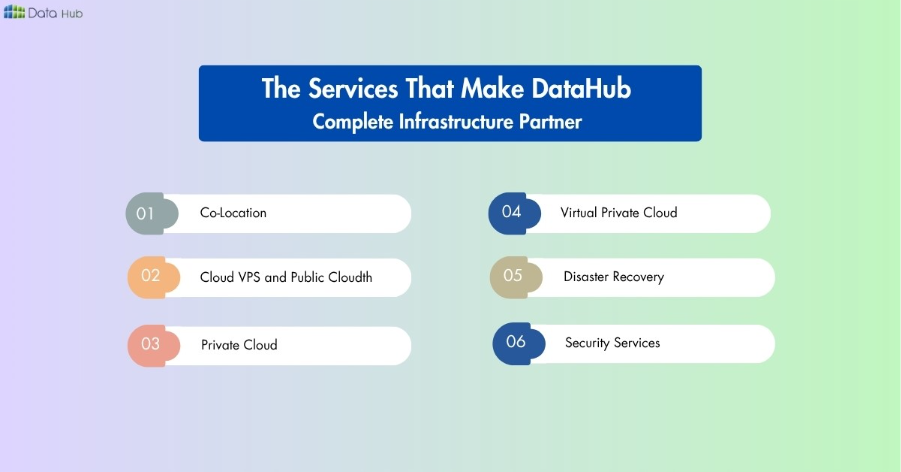
The Services That Make DataHub a Complete Infrastructure Partner
The foundation is a data center. What your organization can do depends on what’s on top of it.
DataHub is a foundation for a complete stack of services, enabling many organizations to consider centralizing their infrastructure with a single provider.
1) Co-location
Co-location allows you to store your own hardware in DataHub’s data centers while enjoying the perks of the facility’s power, cooling, connectivity, and security system without relinquishing control of the hardware.
Not only do clients of co-location connect to the open internet, but they also connect to a veritable cross-section of peers, comprising the ecosystem of cloud platforms, fintech networks, and the nation’s largest carrier networks.
For banks and enterprises that have invested in their own hardware but need a facility that meets regulatory standards, co-location at DataHub provides that environment with complete flexibility over which carriers and services you connect to.
2) Cloud VPS and Public Cloud
It provides a production-ready environment of virtual servers with NVMe SSD storage, dedicated resources, dedicated IP addresses, DDoS protection, and full root access for organizations that do not wish to manage physical infrastructure.
Plans start at Rs. 1,000 per month and scale through the Public Cloud service, with the flexibility to add resources as your workload grows without migrating between environments.
3) Private Cloud
It meets the requirements for complete resource isolation and dedicated infrastructure.
When your compliance requirements or data sensitivity for an environment where no other organization shares your underlying hardware, the Private Cloud option delivers that within the same certified Nepali data center environment.
4) Virtual Private Cloud
Built on top of the cloud environment, VPC provides network-level segmentation, real-time traffic monitoring, and logging.
For organizations running multiple applications that need to communicate securely with each other, the VPC architecture creates the segmented, auditable network that financial and enterprise workloads typically require.
5) Disaster Recovery
Disaster recovery goes beyond backup.
The Disaster Recovery as a Service replicates mission-critical systems to the Butwal data center in real time, with defined Recovery Time Objectives and Recovery Point Objectives aligned to your SLA before any incident occurs.
SIOS High Availability and Disaster Recovery is ideal for organizations requiring zero RPO, real-time block-level replication, and automatic failover, and can achieve 99.99% application uptime for critical applications such as core banking and payment systems.
6) Security Services
Security services span network protection through Firewall as a Service with next-generation virtual firewall appliances and IPS-enabled traffic inspection, application protection through WAF as a Service.
It also provides ransomware protection through NeuShield with Mirror Shielding technology and one-click restore, and data protection through Backup as a Service with automated snapshot scheduling and on-demand restoration.
7) Yeti Cloud
Yeti Cloud is DataHub’s own PaaS platform, a managed container environment that lets development teams deploy code while managing the infrastructure.
It is the most accessible managed application hosting in Nepal, with support for Node.js, Python, PHP, Java, Ruby, and Go, and pay-per-usage billing.
Yeti Cloud is what makes DataHub relevant to not only enterprise IT departments, but to all software development teams creating software for the Nepali market.
Who Has Already Chosen DataHub Nepal as Their Reliable Data Center?
DataHub has already gained the trust of some of the top businesses and companies in Nepal, with the most challenging infrastructure environments.
Among banking and financial services, NMB Bank, Global IME Bank, NIC Asia Laghubitta, Prabhu Bank, Prime Bank, and Laxmi Bank have recognized the available options in Nepal and decided to migrate their operations to DataHub.
These are organizations where a data center failure is a regulatory event, not just an inconvenience.
In fintech and payments, Khalti, Fonepay, eSewa, IME Pay, and Prabhu Pay are the platforms that millions of Nepali citizens use daily to move money and operate on DataHub’s technology.
The performance and security demands of payment processing at a national scale set a standard that the facility consistently meets.
In insurance: Shikhar Insurance, Nepal Life Insurance, and other insurance companies with sensitive policyholder data and claims have made the same decision to have high-availability systems.
In e-commerce and media, Gyapu, Hardware Pasal, Daami Music, and OHO Movies are among the rising players in the digital economy that require fast content delivery, high uptime, and scalability for promotional events.
In addition to big clients in the private sector, DataHub has NGOs, INGOs, Government agencies, Hospitals, Telecom companies, and Software Development firms as clients in Nepal.
Such a diverse client portfolio means that the infrastructure has been stress-tested across virtually every category of workload a Nepali organization might run.
The Local Advantage of DataHub Nepal That Foreign Providers Cannot Replicate
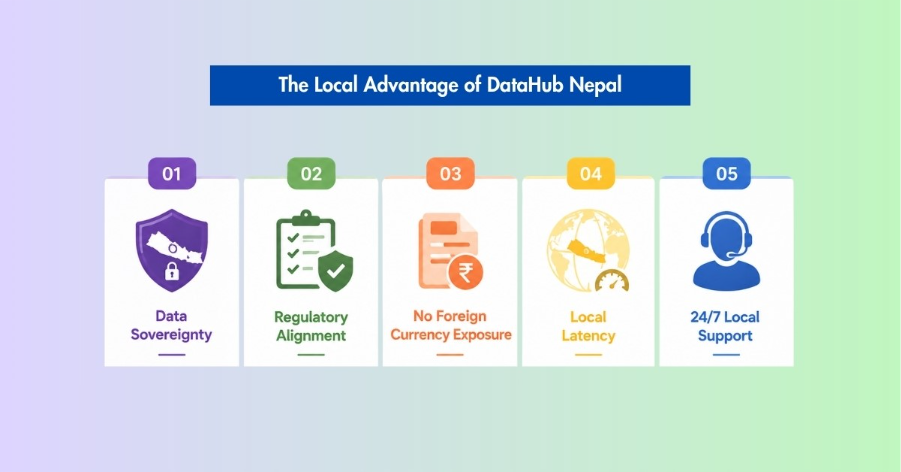
There is a specific set of advantages that come only from choosing DataHub Nepal as the reliable data center in Nepal, and none of them are available from any overseas cloud provider regardless of their global scale.
All these benefits are enough to choose DataHub Nepal as a reliable data center in Nepal, rather than routing your operations through a foreign provider that has no stake in Nepal’s regulatory environment.
1) Data Sovereignty
When your data is stored in Nepal, it is governed by Nepali law. It is accessible to Nepali regulators and not subject to the legal jurisdiction of any foreign government.
2) Regulatory Alignment
DataHub’s infrastructure posture is designed with NRB guidelines, the IT Act, and other data protection requirements for Nepali businesses in mind
There is no need for translation between your regulator’s compliance requirements and your provider’s infrastructure practices.
3) No Foreign Currency Exposure
Globally, payments for cloud services are in dollars. Exchange rate fluctuations and difficulties with international payments in Nepal create problems.
DataHub Nepal payment is billed in Nepali Rupees.
4) Local Latency
For any application serving Nepali users, having your infrastructure inside Nepal means the data does not cross international borders with every request.
The benefits of a local data center in Nepal include response time improvements that affect real user experience, search engine rankings, and application reliability in ways that matter directly to your business outcomes.
5) 24/7 Local Support
DataHub support team is available in Nepal, and you can contact them via phone, email, Viber, or WhatsApp.
They operate in a local time zone, understand the local language, and have comprehensive insight into the Nepali infrastructure, including the power grid, ISPs, and the regulatory landscape.
The Award That Proves the Reliability and What Clients Already Trust
In May 2024, Prime Minister Pushpa Kamal Dahal handed DataHub Nepal the National ICT Award at the 7th National ICT Day ceremony organized by the Ministry of Communication and Information Technology.
DataHub received the award for its exemplary contribution to Nepal’s IT infrastructure and digital landscape.
Awards do not operate data centers. Infrastructure, processes, and people do that.
But the National ICT Award from Nepal’s own Ministry of Communication reflects an independent institutional assessment of DataHub’s contribution to the country’s digital infrastructure over more than a decade of operations.
Choosing a Reliable Data Center in Nepal
The selection of a data center in Nepal isn’t just a technical decision.
It’s a business decision with implications for compliance, business continuity, data sovereignty, cost, and the long-term relationship between your organization and the infrastructure partner powering your systems.
By selecting DataHub Nepal as the trusted data center in Nepal, you are choosing the one that is built by the company that has been operating the first private, global standard Data Center in Nepal.
It holds ISO/IEC 27001 and PCI DSS certifications through continuous operation, and has built the only dual-site DC and DR infrastructure in Nepal.
Datahub Nepal won the National ICT award from the Ministry of Communication and has served the most demanding organizations in the banking sector, fintech, insurance, e-commerce, media, and government.
That’s the conclusion of several top organizations, as well as many others in Nepal.
Explore DataHub Nepal’s data center and cloud services or get in touch with the team to discuss your specific infrastructure needs.
FAQs
Q1. What makes Datahub Nepal a reliable data center choice?
Datahub Nepal is known for local infrastructure, uptime reliability, and dedicated support tailored to Nepali businesses.
Q2. Does Datahub Nepal offer local data storage compliance?
Yes, hosting data within Nepal helps businesses meet local data residency needs and reduces latency for local users.
Q3. What hosting services does Datahub Nepal provide?
Datahub Nepal offers VPS, dedicated servers, colocation, and cloud hosting solutions for businesses of varying sizes.
Q4. How reliable is Datahub Nepal’s uptime and support?
Datahub Nepal focuses on strong uptime commitments backed by responsive local technical support.
Q5. Is Datahub Nepal suitable for small businesses and startups?
Yes, its scalable hosting plans make it accessible for startups while supporting growth into larger infrastructure needs.
Q6. Why is choosing a local data center like Datahub Nepal beneficial over international providers?
Local data centers offer lower latency for Nepali users, easier compliance, and support in local time zones.
