

Thousands of people throughout Nepal are transferring money, paying EMIs, adding to their wallets, and processing payroll. Everything is running smoothly.
Then, there’s a problem at the infrastructure level. The system starts to slow down; transactions start to time out, and in minutes, customers start to call branches.
The bank’s IT staff is in a state of panic. The root cause? An infrastructure solution that wasn’t built to comply with the need for continuity and compliance that a financial institution demands.
This situation has occurred in Nepal and all over the world. In almost all cases, post-incident reviews show that the hosting environment was not configured for the industry it hosted.
The banking and fintech scene in Nepal has progressed much more quickly.
Currently, there are more than 25 Payment Service Providers (PSP) licensed by Nepal Rastra Bank.
Digital wallets such as Khalti and platforms such as Fonepay facilitate millions of transactions every day and are linked to a national payments network that links banks, merchants, and consumers.
Commercial banks, such as NMB Bank and NIC Asia, have millions of active customers who rely on their mobile banking apps at midnight, not just during working hours.
All of this must have compliance-ready VPS infrastructure in Nepal to support it.
Learn more: Power Your Business Growth with Reliable VPS Hosting in Nepal
Table of contents
- What Makes Financial Infrastructure Different from Other Sectors?
- Where Do Most Financial Institutions Fall Short During Hosting?
- What a Compliance-Ready VPS Setup for Banks Actually Looks Like
- VPS Hosting Trusted by Several Top Fintech Companies in Nepal
- The Data Sovereignty Argument Is Stronger Than Most Institutions Realize
- The Latency Factor in Financial Applications
- Seamless Upgrade with DataHub Nepal
- The Importance of VPS Hosting for Fintech Companies in Nepal
What Makes Financial Infrastructure Different from Other Sectors?
In today’s digital landscape, speed and security are the priority for most businesses.
All that and a set of specific, non-negotiable infrastructure requirements, which are baseline standards set by Nepal Rastra Bank and the institutions themselves, are needed by banks and fintech companies.
The data should be stored in Nepal. This is not optional.
In accordance with the NRB guidelines, customers’ financial information needs to be stored within the country. It creates a compliance risk.
All audit logs should be present and available.
Financial regulators can request transaction logs, access, and system activities at any time. A system that cannot generate clean, complete records on demand is a liability in any regulatory review.
Systems need to be available. A fintech’s core banking system or payment gateway cannot be down for maintenance on a Saturday.
A maintenance window that affects customers’ transactions is unacceptable when people rely on such services in their everyday lives.
Disaster recovery needs to be authentic, tested, and locally based.
Even if you have a backup, that doesn’t mean you have a disaster recovery plan that works.
If a BFI has never tested its failover process, it doesn’t really know whether it will work when the time comes.
Security needs to be multi-layered and documented. The threats are real, and the consequences of a breach to a financial institution are severe.
Where Do Most Financial Institutions Fall Short During Hosting?
If you enter the IT department of a medium-sized bank or fintech in Nepal, you will see that it was built years ago and has been expanded without any proper architecture.
As needed, servers were added. When the first scare occurred, backup solutions were added. Security tools are not being actively monitored.
What regulators expect and what customers deserve is a compliance-ready setup that’s very different than what many institutions are running.
Most IT heads in Nepal’s financial sector know what good infrastructure is.
The issue is usually that the provider doesn’t truly grasp the regulatory landscape, keep data in Nepal, offer the multi-layered services required to ensure financial compliance, and be reachable quickly when things go wrong.
You may find it useful: VPS or Dedicated Server? Most Nepali Businesses Are Overpaying for the Wrong Choice
What a Compliance-Ready VPS Setup for Banks Actually Looks Like
The foundation is a cloud VPS environment running in Nepal.
This is non-negotiable for regulatory compliance. DataHub Nepal has two certified data centers in Kathmandu and Butwal, with a Tier-III data center standard and ISO/IEC 27001:2013 certification.
Both data centers are also PCI DSS compliant, the payment card industry’s own data security standard.
They are the genuine certifications that are documented, audited, and withstand regulatory review.
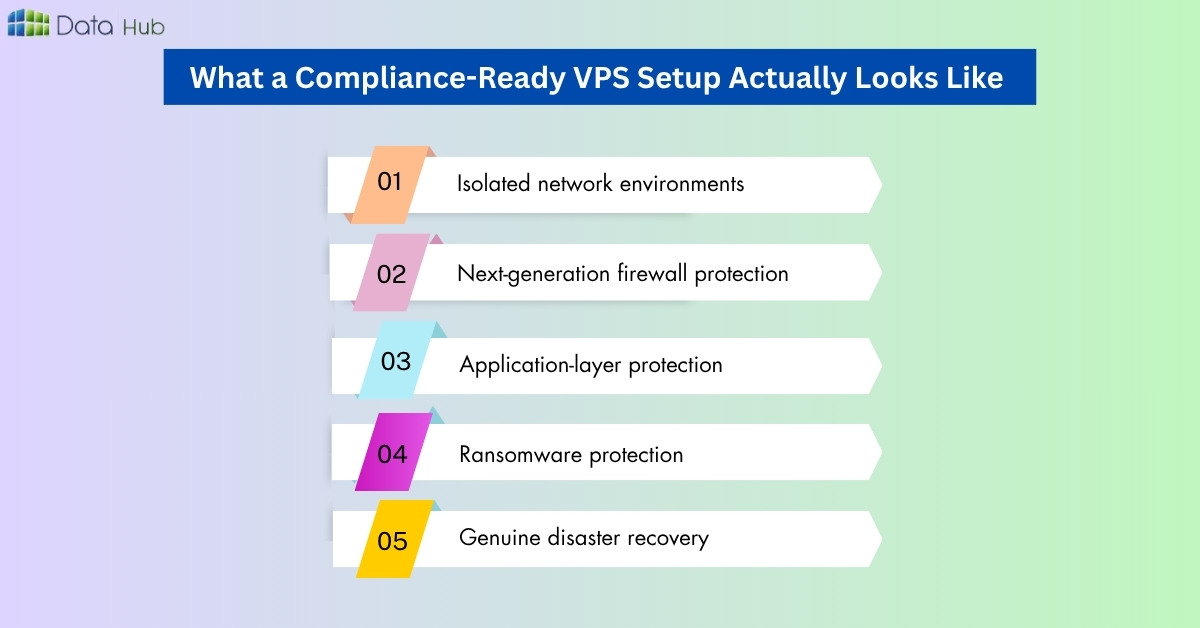
Building on this foundation, a compliant financial infrastructure requires certain layers.
1) Isolated network environments
A payment gateway cannot be on the same network segment as an internal HR application.
A core banking system must be separated from web-facing services.
The Virtual Private Cloud architecture enables segmentation into separate, isolated environments that communicate only through controlled, monitored channels.
Real-time traffic visibility and logging are built in, so your audit trail is always up to date.
2) Next-generation firewall protection
It isn’t just a simple firewall. The Firewall as a Service from DataHub provides next-generation Virtual Firewall Appliances (VFA) with IPS support, instant visibility, and instant policy enforcement across your infrastructure.
It involves checking and recording all interactions in and outside the financial institution’s environment. IPS can proactively detect network vulnerabilities that can lead to an incident.
3) Application-layer protection
Your mobile banking app, Internet banking portal, and customer-facing APIs are constantly exposed to the internet.
WAF as a Service exists in the middle of these applications and the open internet, and protects your systems from injection attacks, cross-site scripting attempts, and other web-based threats before they reach your systems.
This is a must for any institution that has financial applications that are open to the public.
4) Ransomware protection
Financial institutions are among the most targeted sectors for ransomware attacks worldwide, and Nepal is no exception.
NeuShield Ransomware Protection with patented Mirror Shielding technology is now available on DataHub to protect files from ransomware by denying access to the original files.
NeuShield is zero-day-ready, unlike traditional antivirus solutions that rely on known signatures. One-Click Restore will restore the system back in minutes, not days, if an attack does get through.
When a bank loses an hour of its operations, it loses several transactions and faces regulatory risk. That recovery speed is a huge deal.
5) Automated backup with point-in-time restoration
Backup as a Service creates scheduled image snapshots that can be retrieved when needed in your live environment. This is the baseline.
A bank that cannot restore to a specific point in time before a corruption event, a ransomware attack, or a failed update cannot meet its continuity obligations.
6) Genuine disaster recovery
Backup is not the same as Disaster Recovery. Backup helps to keep your data safe.
Disaster recovery safeguards your operations. Disaster Recovery as a Service is a system that replicates mission-critical systems to the Butwal data center in real time, so that if the Kathmandu server goes down, the failover is ready to activate.
Before any problem arises, Recovery Point Objectives and Recovery Time Objectives are aligned with your SLAs.
When institutions require the highest level of application-level continuity, SIOS High Availability and Disaster Recovery provide real-time block-level replication, automatic failover, and 99.99% uptime for critical applications such as core banking systems and payment switch software with zero RPO.
7) Private or dedicated cloud for sensitive workloads
Not all workloads in a bank need to run on a shared cloud infrastructure.
A private cloud environment’s resource isolation and secure environment are ideal for Core Banking Engines, KYC databases, and transaction processing systems.
With Private Cloud at DataHub, you’ll have all the infrastructure, control, and the same model of support as with a private cloud, but without all the hassle of managing physical infrastructure yourself.
That’s why VPS hosting is very helpful for fintech companies in Nepal.
VPS Hosting Trusted by Several Top Fintech Companies in Nepal
The best way to assess an infrastructure provider for your financial institution is to see which other financial institutions have already made that evaluation and reached a decision.
DataHub Nepal caters to all segments of Nepal’s financial institutions.
NMB Bank is one of the licensed A-class Commercial Banks in Nepal, with 200+ branches and 1900+ employees, and operates with DataHub’s infrastructure.
Global IME Bank is a top client of the DataHub, which is one of the biggest commercial banks in Nepal.
NIC Asia Laghubitta, one of the top microfinance organizations, has highlighted DataHub’s quick response and service reliability as the basis for the continued partnership.
Shikhar Insurance, a prominent name in the Nepalese insurance sector, has highlighted its 24/7 local support.
Khalti, one of the most popular digital wallets and payment service providers in Nepal, and Fonepay, the country’s licensed Payment System Operator (PSO) between banks, wallets, and merchants, both trust DataHub’s infrastructure.
These are not small or casual clients. These are the organizations whose infrastructure failures directly and measurably impact millions of Nepalese citizens.
The fact that they chose DataHub Nepal, and their continued trust, says something a spec sheet cannot.
DataHub Nepal was also recognized as the winner of the National ICT Award 2024, an acknowledgment of its contribution to Nepal’s IT infrastructure from within the industry itself.
The Data Sovereignty Argument Is Stronger Than Most Institutions Realize
In addition to regulatory compliance, there is a real need for in-country financial infrastructure that is often overlooked.
If your transaction data, customer KYC information, and account information are stored in a foreign data center, you are subject to the legal jurisdiction of that country.
Even when a foreign government or law enforcement agency requests access to data on servers located in their territory, your institution may have limited options.
This is not a possible risk but a real possibility. It is a documented reality in multiple jurisdictions globally.
If your data is stored in Nepal, it will be under Nepal’s jurisdiction. All your institutions, your regulator, and your customers operate within a legal framework that is transparent and accountable to institutions in Nepal.
The benefits of keeping data in a local data center go beyond speed and latency. For a financial institution, data sovereignty is a compliance posture, a customer trust position, and a risk management decision all wrapped into one.
The Latency Factor in Financial Applications
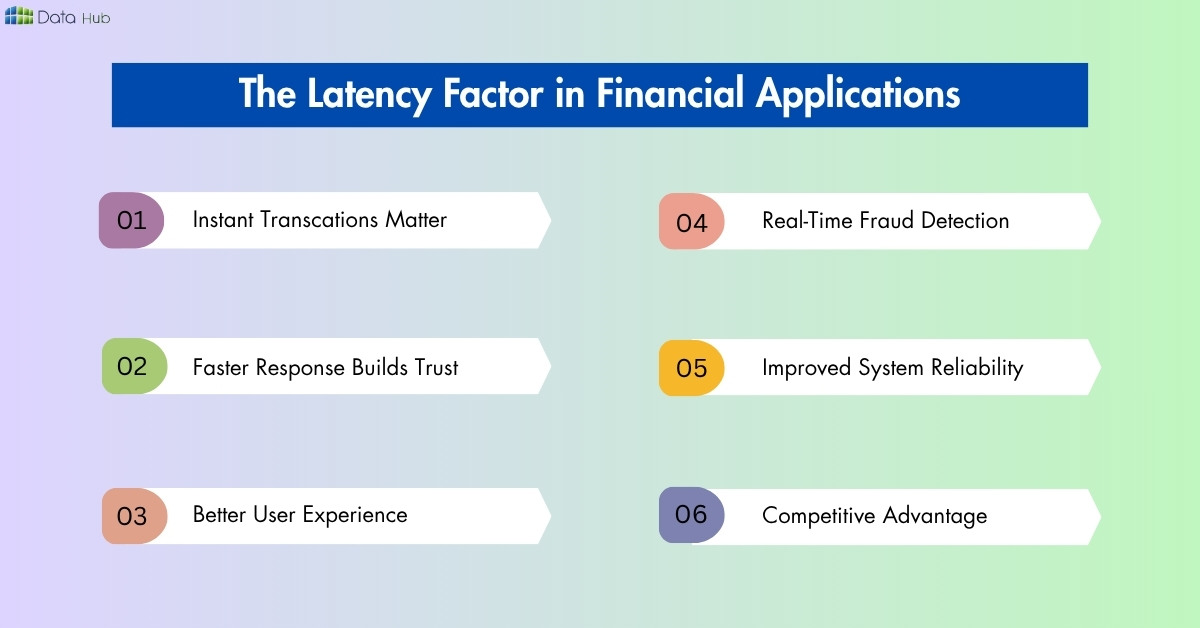
Nepalese mobile banking users do not want latency to be a problem.
People who create and operate those apps know that response time isn’t only about the user experience. It is technically required in financial applications.
Low latency is essential for transaction processing systems, payment gateways, and real-time balance queries to operate.
With infrastructure hosted in a different country, each API request, database query, and session authentication requires data to cross borders and return. That overhead accumulates with thousands of simultaneous sessions.
That’s where locally hosted VPS infrastructure in Nepal comes in handy. Your data remains in the country, response times are as expected, and your app works as designed.
The blog on the importance of website speed for businesses in Nepal delves deeper into how a hosting location directly affects performance and how a web host’s services can enhance it.
Seamless Upgrade with DataHub Nepal
Migration risk is a concern for many IT teams in financial institutions. It’s not as eas
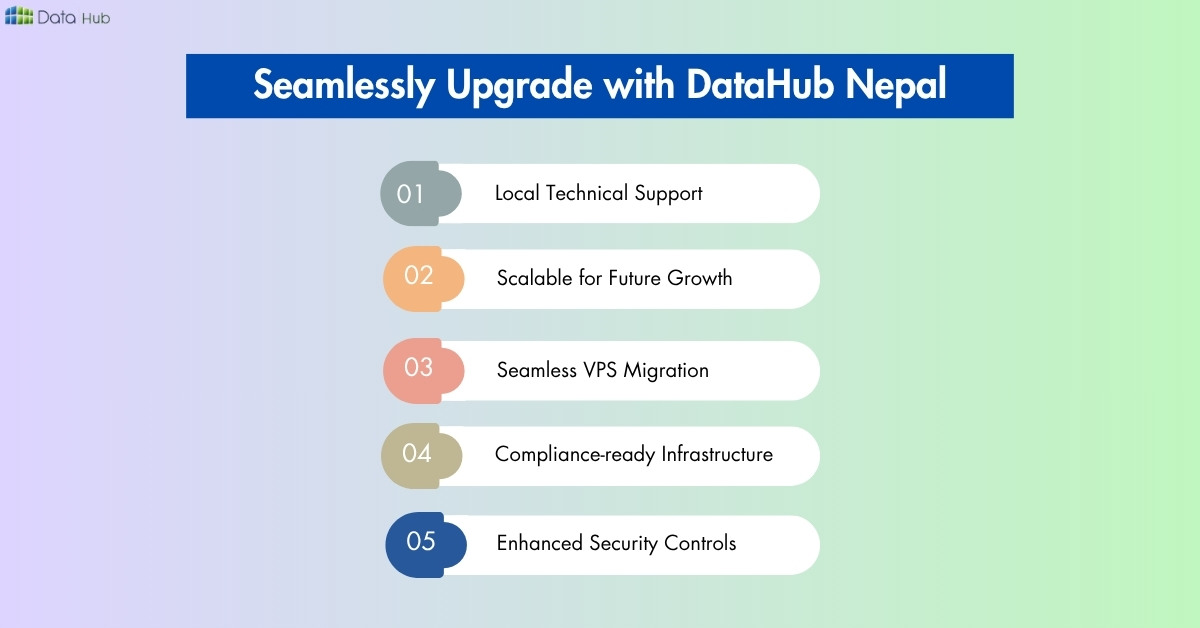
Migration risk is a concern for many IT teams in financial institutions. It’s not as easy as it sounds to move infrastructure while it’s live and processing transactions. The caution is understandable.
The good news is that you don’t have to wait forever. DataHub’s team has helped finance-sector organizations in Nepal through the infrastructure transition process in a manner appropriate to financial-sector operations.
If you’re looking for guidance on what your situation would require, talk to the DataHub team about your compliance infrastructure.
The Importance of VPS Hosting for Fintech Companies in Nepal
Nepal’s financial sector is more digital, more connected, and more vulnerable to infrastructure risks than it was 5 years ago.
NRB’s expectations for compliance have matured. Financial data is under a different level of threat these days.
And the gap between what a well-configured, compliance-ready VPS setup looks like and what many institutions are actually running has become more consequential.
The compliance-ready setup is not complicated in concept.
It means in-country hosting at a certified data center, network segmentation, next-generation firewall protection, app-level WAF coverage, ransomware protection, automatic backups, and tested disaster recovery.
And 24/7 local support from individuals familiar with the Nepali financial environment.
The difficulty is finding a provider in Nepal that offers everything under one roof and has a proven track record in the sector.
DataHub Nepal has been that provider for NMB Bank, Global IME Bank, NIC Asia Laghubitta, Shikhar Insurance, Khalti, Fonepay, and more than a thousand other organizations across Nepal.
It was designed in 2012 to meet the challenges of the local market, is certified to international standards, and has a local team available 24/7.
