


Imagine your Dashain offer finally takes off. Hundreds of shoppers rush to your website after seeing your Facebook or TikTok promotion. Product pages begin loading slowly. The cart starts timing out. Then the checkout stops working.
Surviving Dashain/Tihar Traffic Spikes is not just a technical concern; it can decide whether your biggest sales opportunity of the year becomes a success or a costly missed chance.
Key Highlights
- Auto-scaling keeps online stores running smoothly
- Festival traffic can overwhelm unprepared websites
- Scalable hosting protects valuable sales opportunities
- DataHub’s Yeti Cloud platform combines automated containers, automatic scaling, load balancing and pay-per-usage billing.
Nepali online shopping has already shown strong seasonal demand: online shopping businesses reported roughly 30–40% higher business during Dashain in one reported peak season.(Source:Republica news/ Sales of online shopping sites up 40% during Dashain)
For businesses preparing for the next festival, Datahub’s Nepal has Yeti Cloud platform that offer a practical place to start.
Table of contents
- Key Highlights
- Why Dashain and Tihar Can Push Your Online Store to Its Limit?
- What Happens When Your Website Cannot Handle Peak Traffic?
- What Is Auto-Scaling and How Does It Work?
- Vertical vs Horizontal Scaling: What Does Your Store Need?
- Why Auto-Scaling Matters for Nepali E-Commerce Businesses?
- Auto-Scaling Is Only One Part of Peak-Season Readiness
- What Should You Test Before Dashain and Tihar?
- How DataHub Nepal Can Help Your Online Shop to Prepare?
- A Simple Peak-Traffic Plan for Nepali Online Stores
- Conclusion
- Frequently Asked Questions
Why Dashain and Tihar Can Push Your Online Store to Its Limit?
Festival shopping changes customer behaviour.
People who normally browse casually suddenly start looking for clothes, electronics, gifts, decorations, groceries, beauty products and other essentials at the same time. Businesses respond with discounts, social media campaigns, influencer promotions and limited-time offers.
That creates a traffic pattern very different from an ordinary business day.
You might have 100 visitors at 10 a.m., 300 at noon and several thousand after a promotional post goes viral. Your website has to cope with the increase without making customers wait.
This is where Surviving Dashain/Tihar Traffic Spikes becomes a hosting decision rather than simply a marketing concern.
Nepal’s e-commerce market is still developing, but online activity is increasingly mobile-led. The U.S. International Trade Administration reports that almost 60% of Nepalis have internet access and more than 95% of internet users access the internet through mobile phones. A slow mobile checkout can therefore affect a large share of potential customers.
And customers do not usually wait around.
If one store is slow, they can move to another.
What Happens When Your Website Cannot Handle Peak Traffic?
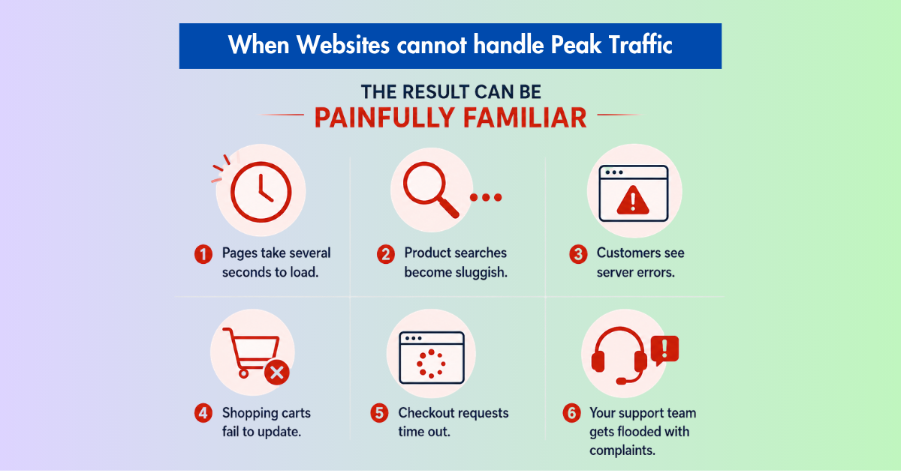
Think of your hosting environment as the workspace behind your online shop.
On a normal day, the available computing power may be enough. But when thousands of shoppers arrive together, the same resources have to handle more page requests, searches, product images, carts, logins and payments.
The result can be painfully familiar:
- Pages take several seconds to load.
- Product searches become sluggish.
- Customers see server errors.
- Shopping carts fail to update.
- Checkout requests time out.
- Your support team gets flooded with complaints.
This is why Surviving Dashain/Tihar Traffic Spikes should be planned before the first major promotion goes live.
Simply buying the largest server you can afford is not always the smartest answer. You may end up paying for capacity that sits unused for most of the year.
A better approach is to make your infrastructure capable of responding to demand.
What Is Auto-Scaling and How Does It Work?
Autoscaling, sometimes known as automatic scaling, is an aspect of cloud computing whereby computation resources are assigned based on system requirements.
Auto scaling is employed to ensure that there are enough resources for applications to be available and meet their performance objectives.
The use of auto-scaling facilitates effective resource utilization in the cloud and reduces cloud expenses.
Your infrastructure watches workload demand. When demand rises, it can increase available resources. When demand falls, it can reduce them again.
In other words, your online store does not have to operate with exactly the same computing capacity during a quiet Tuesday and a busy festival evening.
That principle is at the heart of Surviving Dashain/Tihar Traffic Spikes.
DataHub’s Yeti Cloud provides automatic vertical and horizontal scaling, alongside automated traffic distribution and load balancing.
That gives Nepali businesses a way to prepare infrastructure for changing workloads without treating every traffic increase as an emergency.
Vertical vs Horizontal Scaling: What Does Your Store Need?
There are two basic ways to increase capacity.
Vertical scaling means giving an existing environment more resources, such as additional CPU or memory.
Horizontal scaling means adding more running instances or application resources so the workload can be distributed.
You do not need to become a cloud engineer to understand the difference.
If your online store experiences predictable increases around festival promotions, the important question is whether your hosting environment can increase capacity quickly enough and distribute demand properly.
For Surviving Dashain/Tihar Traffic Spikes, flexibility matters more than simply having a powerful server.
DataHub’s Yeti Cloud platform combines automated containers, automatic scaling, load balancing and pay-per-usage billing. That combination is particularly relevant for businesses whose traffic can change dramatically from one period to another.
Why Auto-Scaling Matters for Nepali E-Commerce Businesses?
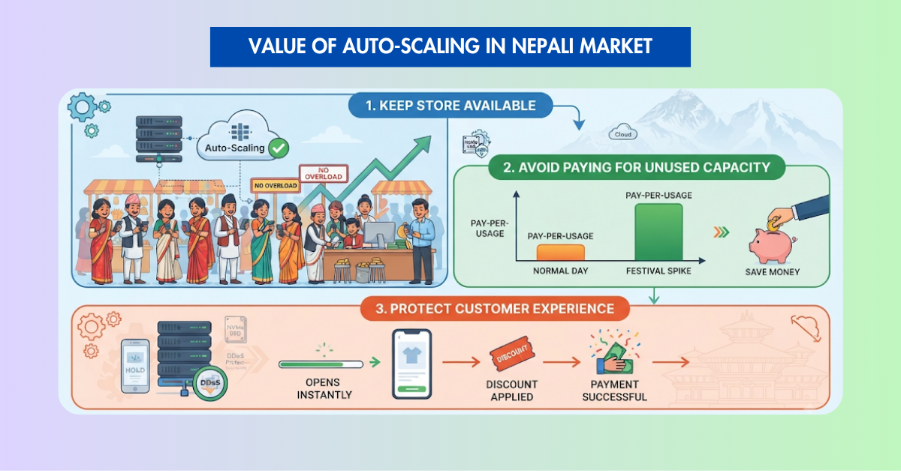
1. Keep Your Store Available During Demand Surges
The first benefit is obvious: customers can continue browsing and buying when demand jumps.
A successful festival campaign should create orders, not server tickets.
For Surviving Dashain/Tihar Traffic Spikes, high availability needs to be treated as part of the sales strategy. DataHub’s Nepal-based data center infrastructure includes redundant power and cooling systems, 24/7 monitoring and carrier-neutral networking, designed around reliable infrastructure.
2. Avoid Paying for Maximum Capacity All Year
A common response to peak traffic is to permanently purchase enough capacity for the busiest possible day.
That can be expensive.
Most stores do not experience festival-level demand every week.
A scalable environment gives you more flexibility. You can increase resources as demand grows and reduce unnecessary capacity when the rush is over.
That makes Surviving Dashain/Tihar Traffic Spikes more financially sensible than simply overprovisioning your infrastructure for months.
DataHub also highlights pay-per-usage billing through Yeti Cloud, allowing businesses to align resource consumption more closely with actual workload.
3. Protect the Customer Experience
Your customer does not care whether the problem is CPU usage, memory pressure or server capacity.
They care whether the product page opens.
They care whether the discount applies.
They care whether the payment goes through.
That is why Surviving Dashain/Tihar Traffic Spikes should include performance planning, not just server capacity.
DataHub’s Cloud VPS hosting options include NVMe SSD storage, dedicated resources, DDoS protection and dedicated IP addresses. These features can help create a stronger foundation for stores that are preparing for heavier workloads.
Auto-Scaling Is Only One Part of Peak-Season Readiness
Scaling can resolve the problem of infrastructure, but it does not address all weaknesses of an online shop.
Your database still needs to handle orders.
Your payment gateway still needs to react.
Your product images still need to be optimized.
Your website code still needs to be tested.
Your inventory system needs to stay updated.
And your store still needs a recovery plan for any case of emergency.
For Surviving Dashain/Tihar Traffic Spikes, think beyond the server.
As we saw above, DataHub’s e-commerce hosting infrastructure takes into account online shops specifically, pointing out scalability, fast page loading and secure transaction. DataHub also provides e-commerce clients like Gyapu and Hardware Pasal with its VPS hosting.
Why do we mention it? Because not the most extensive list of features, but rather the hosting that will match the demands of your store is the best one.
What Should You Test Before Dashain and Tihar?
Do not test your store when the first big sale has already happened.
Start with the practical list of items to test.
Test your expected traffic. Make the estimation of how many visitors can come through your marketing campaign and then test more than that amount.
Test your checkout. No matter how fast your site is, it still loses you money, if people face difficulties with payments.
Test your hosting resources. See what your CPU, memory, storage and network work in under high demand.
Test your database. Product search, account login, and order creation can overload the database of your shop.
Test your security. Festivals can attract not only regular customers, but also hackers.
Prepare your recovery procedure. Make sure you know what will happen, if something goes wrong in the primary environment.
Such preparation is crucial for Surviving Dashain/Tihar Traffic Spikes.
In this case DataHub Nepal disaster recovery service allows the multi-site replication, support of multiple platforms and encrypted data for businesses.
How DataHub Nepal Can Help Your Online Shop to Prepare?
The right infrastructure depends on the size of your store, its application architecture, expected traffic and budget.
Small store will need a properly configured cloud VPS with room to scale. A growing e-commerce operation may need broader cloud resources, load balancing and more advanced application hosting.
For businesses looking beyond a basic VPS, DataHub’s cloud hosting guide explains how cloud infrastructure can provide scalability, performance and reliability compared with traditional hosting.
For Surviving Dashain/Tihar Traffic Spikes, that flexibility can be valuable.
DataHub also operates data centers in Kathmandu and Butwal, giving businesses access to locally hosted infrastructure and support. Its data center selection guide covers factors such as reliability, security, scalability and business continuity when evaluating infrastructure.
The goal is not to make your technology unnecessarily complicated.
It is to make sure your hosting can keep pace when your customers arrive.
A Simple Peak-Traffic Plan for Nepali Online Stores
If your Dashain or Tihar campaign is approaching, use this sequence:
Four weeks before: Review last year’s traffic, sales and busiest hours.
Three weeks before: Estimate your expected peak and identify your infrastructure limits.
Two weeks before: Test the website under increased load and review checkout performance.
One week before: Confirm monitoring, backups, security and recovery procedures.
During the campaign: Watch performance continuously instead of waiting for customers to report problems.
After the campaign: Scale down unused capacity and review what happened.
This approach turns Surviving Dashain/Tihar Traffic Spikes from a last-minute technical scramble into a planned business process.
Conclusion
A successful Dashain or Tihar campaign should leave you checking new orders, not refreshing a server dashboard.
Festival traffic is an opportunity. But opportunity becomes revenue only when your online store remains available, responsive and ready to process orders.
That is the real lesson behind Surviving Dashain/Tihar Traffic Spikes. You do not have to build an oversized infrastructure just because your traffic might spike. You need infrastructure that can respond when demand changes.
From scalable cloud environments and automated scaling to load balancing, security and disaster recovery, DataHub Nepal can help businesses build a more resilient foundation for peak-season selling.
If your store is preparing for the next major sales rush, explore DataHub Nepal’s Paas known as “ Yeti Cloud” one of the trusted infrastructure solutions and plan your capacity before customers start clicking “Buy Now.”
Frequently Asked Questions
It can help reduce the risk caused by sudden increases in workload by making additional resources available as demand changes. However, your application, database, payment system and other components must also be capable of handling increased demand.
Yes, particularly when traffic is unpredictable. A small store does not necessarily need massive infrastructure all year.
If your current hosting regularly struggles during promotions, moving before the festival rush gives you time to test the new environment. Do not wait until traffic is already high.
It can. Instead of permanently maintaining resources for your highest possible traffic level, scalable infrastructure can let you match resources more closely with workload. Actual savings depend on your application and hosting configuration.
