

A ransomware attack is a type of cyber-attack in which a hacker or a group of hackers encrypts the files on a victim’s computer or network, making them inaccessible.
When the victim requests the decryption key to get back access to their data, the attacker responds by demanding a ransom, generally in the form of cryptocurrencies.
This type of attack has become increasingly common in recent years, with the number of attacks increasing dramatically.
This type of malware can lock your files or device and hold them hostage until a payment, often in cryptocurrency, is made to unlock them.
It’s similar to having a digital kidnapper demanding money for the return of your data.
Table of contents
- Ransomware Attacks Are Increasing Across Key Sectors in Nepal
- Top Causes of Ransomware Attacks in Nepal
- 1. Phishing Emails & Social Engineering:
- 2. Weak Password Practices:
- 3. Unsecured Remote Desktop Protocol (RDP):
- 4. Outdated Software & Systems:
- 5. Lack of Regular Data Backup:
- 6. Poor Network Security Configuration:
- 7. Low Cybersecurity Awareness:
- 8. Use of Pirated or Cracked Software:
- 9. Insecure Public Wi-Fi Usage:
- 11 Critical Things to Consider When Choosing Ransomware Protection in Nepal
- 1. Real-Time Threat Detection (Beyond Basic Antivirus):
- 2. Secure & Isolated Backup Infrastructure:
- 3. Disaster Recovery Capabilities (RTO & RPO Clarity):
- 4. Local Data Hosting & Compliance Alignment:
- 5. Protection Against Double Extortion Attacks:
- 6. 24/7 Monitoring & Incident Response Support:
- 7. Secure Cloud & Hybrid Infrastructure Support:
- 8. Strong Access Control & Multi-Factor Authentication (MFA):
- 9. Network Segmentation & Firewall Protection:
- 10. Scalability & Future-Readiness:
- 11. Reputation, Reliability & Local Expertise:
- Why Secure Infrastructure Is the First Line of Defense Against Ransomware in Nepal?
- Why DataHub Nepal’s NeuShield Anti-Ransomware Is the Backbone of Cyber Security in Nepal?
- Why Preventing Ransomware Is Cheaper Than Recovering from It?
- Conclusion
- FAQs
Ransomware Attacks Are Increasing Across Key Sectors in Nepal
1. Banks & Financial Institutions:
Financial institutions are prime targets because they manage high-value transactions and sensitive customer data. A successful ransomware attack can:
- Disrupt online banking and ATM services
- Compromise financial records
- Trigger regulatory penalties
- Damage public trust instantly
2. Educational Institutions:
Schools, colleges, and universities increasingly rely on digital records, online portals, and cloud systems. However, many operate with limited cybersecurity budgets.
Ransomware here can:
- Lock student databases
- Disrupt examinations and admissions
- Expose personal data
- Halt academic operations
3. Hospitals & Healthcare Providers:
Healthcare is one of the most sensitive sectors. When systems go down:
- Patient records become inaccessible
- Diagnostic systems may stop functioning
- Emergency response slows down
4. SMEs (Small & Medium Enterprises):
Many SMEs believe they are “too small” to be targeted. In reality, they are often the easiest targets.
Why?
- Weak email filtering
- No dedicated IT security team
- Poor backup strategy
- Shared credentials
For SMEs, a ransomware attack can mean:
- Permanent data loss
- Operational shutdown
- Loss of client confidence
5. Government Offices:
Government departments manage large volumes of citizen data and public records. A ransomware incident here can:
- Delay public services
- Create national security risks
- Leak confidential data
- Undermine public confidence
6. IT Companies & Digital Agencies:
Ironically, tech companies are highly targeted because they hold client data and system access credentials.
One compromised IT firm can:
- Infect multiple client networks
- Cause supply chain attacks
- Led to mass data encryption
With secure, compliant, and scalable infrastructure designed for Nepal’s digital ecosystem, DataHub Nepal helps organizations build resilience against ransomware threats.
When your data is your most valuable asset, your infrastructure partner matters.
Top Causes of Ransomware Attacks in Nepal
1. Phishing Emails & Social Engineering:
- Fake emails posing as banks, vendors, government offices, or courier services.
- Malicious attachments disguised as invoices, bills, or official letters.
- Fraudulent links that steal login credentials.
2. Weak Password Practices:
- Using simple passwords like “123456” or “admin.”
- Reusing the same password across multiple platforms.
- No multi-factor authentication (MFA) is enabled.
- Shared login credentials among staff.
3. Unsecured Remote Desktop Protocol (RDP):
- Open RDP ports exposed to the internet.
- No strong authentication on remote access systems.
- Lack of IP restrictions or firewall controls.
4. Outdated Software & Systems:
- Unpatched Windows systems
- Expired software licenses
- Unsupported operating systems
- Delayed security updates
5. Lack of Regular Data Backup:
- No automated backup strategy
- Backups stored on the same infected network
- No offline or cloud backup copy
6. Poor Network Security Configuration:
- No firewall or improperly configured firewall
- No network segmentation
- All devices are connected to a single flat network
7. Low Cybersecurity Awareness:
- Employees are unaware of phishing risks
- No internal cybersecurity training
- No incident reporting procedure
8. Use of Pirated or Cracked Software:
- Downloading software from unverified sources
- Installing cracked applications containing hidden malware
- Disabling security tools to bypass activation
9. Insecure Public Wi-Fi Usage:
- Accessing business systems over unsecured networks
- No VPN protection
- Logging into sensitive accounts from shared
11 Critical Things to Consider When Choosing Ransomware Protection in Nepal
Below are 11 critical factors you must evaluate before selecting ransomware protection in Nepal.
1. Real-Time Threat Detection (Beyond Basic Antivirus):
- Traditional antivirus software only detects known malware signatures.
- Modern ransomware uses behavioral evasion and zero-day exploits.
- Look for AI-driven monitoring and Endpoint Detection & Response (EDR).
- Ensure threats are detected before encryption spreads across the network.
2. Secure & Isolated Backup Infrastructure:
- Follow the 3-2-1 backup strategy (3 copies, 2 formats, 1 offsite).
- Backups must be isolated from the primary network.
- Test recovery regularly, not just backup creation.
- Ensure encrypted backup storage.
DataHub Nepal offers secure data hosting and backup environments that reduce dependency on vulnerable on-site systems.
3. Disaster Recovery Capabilities (RTO & RPO Clarity):
- Ask: How fast can my systems be restored?
- What is the Recovery Time Objective (RTO)?
- What is the Recovery Point Objective (RPO)?
- Is disaster recovery tested or only promised?
4. Local Data Hosting & Compliance Alignment:
- Understand where your data is physically stored.
- Ensure regulatory compliance (NRB, financial sector, health sector).
- Choose providers that understand Nepal’s legal and infrastructure landscape.
DataHub Nepal provides local enterprise-grade data center infrastructure, offering better latency, control, and compliance assurance.
5. Protection Against Double Extortion Attacks:
Modern ransomware:
- Encrypts your data
- Steals your data
- Threatens to publish it
Your solution must include:
- Data loss prevention
- Network segmentation
- Access control monitoring
6. 24/7 Monitoring & Incident Response Support:
Cyber attacks do not follow office hours.
You must ask:
- Is there active monitoring 24/7?
- Who responds if an attack happens at midnight?
- Is there a dedicated technical response team?
7. Secure Cloud & Hybrid Infrastructure Support:
Many businesses in Nepal now use:
- Microsoft 365
- Google Workspace
- Hybrid servers
- Remote working systems
Your ransomware protection must extend beyond on-premise systems.
DataHub Nepal supports secure cloud environments and scalable infrastructure designed for Nepalese enterprises transitioning to digital operations.
8. Strong Access Control & Multi-Factor Authentication (MFA):
- Enforce strong password policies.
- Implement multi-factor authentication.
- Limit admin-level access.
- Monitor unusual login patterns.
Credential theft remains one of the primary entry points for ransomware in Nepal.
9. Network Segmentation & Firewall Protection:
- Avoid flat network structures.
- Segment departments and sensitive systems.
- Deploy enterprise-grade firewall solutions.
- Restrict unnecessary remote access (RDP).
10. Scalability & Future-Readiness:
- Can the solution scale as your business grows?
- Does it support additional storage, cloud integration, and new users?
- Is it flexible for startups as well as enterprises?
A solution that cannot grow with your business will eventually create vulnerabilities.
11. Reputation, Reliability & Local Expertise:
Before choosing a provider, ask:
- Do they have a strong track record?
- Do they understand Nepal’s infrastructure challenges?
- Do they provide reliable uptime and data center standards?
- Can they support both individuals and enterprise clients?
Choosing ransomware protection isn’t about the cheapest software; it’s about a reliable partner.
DataHub Nepal offers secure hosting, enterprise-grade infrastructure, scalable cloud solutions, and disaster recovery, powered with NeuShield Data Sentinel for advanced anti-ransomware protection tailored to Nepal’s businesses.
Why Secure Infrastructure Is the First Line of Defense Against Ransomware in Nepal?
Ransomware is no longer just a malware issue; it is an infrastructure weakness issue.
In Nepal’s growing digital economy, many businesses rely only on antivirus or security software. But software alone cannot protect a poorly structured system.
Real protection begins with a secure infrastructure.
1. Software Alone Cannot Stop Modern Ransomware:
Today’s ransomware:
- Bypasses traditional antivirus
- Spreads across networks
- Targets backup systems
- Steals data before encrypting
If your network, servers, and backup systems are not securely designed, even advanced software can fail. Security tools are important, but they must operate on top of a strong infrastructure.
2. Secure Infrastructure Prevents Large-Scale Damage:
A strong infrastructure includes:
- Enterprise-grade data hosting
- Network segmentation
- Isolated backups
- Firewall protection
- High-availability systems
When infrastructure is secure, attacks are contained quickly, downtime is reduced, and recovery becomes manageable.
3. Why Local, Reliable Infrastructure Matters in Nepal?
Nepalese businesses face:
- Growing cyber threats
- Limited internal security teams
- Increasing regulatory expectations
Partnering with a secure and reliable infrastructure provider adds a critical defensive layer beyond basic hosting.
DataHub Nepal not only delivers enterprise-grade data center and cloud infrastructure, but also serves NeuShield Data Sentinel, an advanced ransomware protection solution.
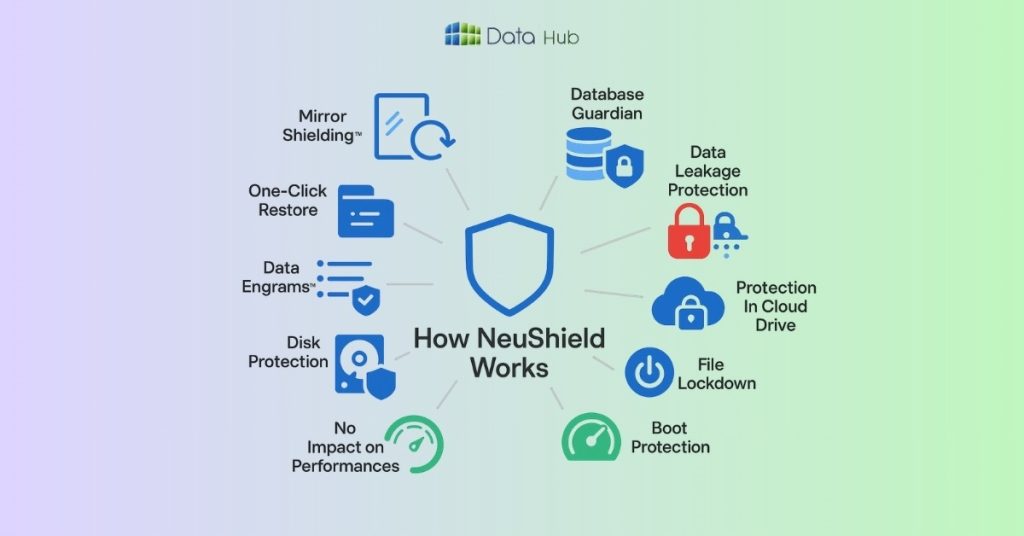
NeuShield features Mirror Shielding technology, which automatically creates invisible backup copies of files, enables fast file recovery without paying ransom, and protects against real-time encryption-based attacks.
By combining secure infrastructure with intelligent endpoint ransomware protection.
DataHub Nepal helps organizations reduce exposure at both the system and data levels.
Why DataHub Nepal’s NeuShield Anti-Ransomware Is the Backbone of Cyber Security in Nepal?
DataHub Nepal strengthens national cyber resilience by serving NeuShield Data Sentinel, delivering advanced, data-level protection against encryption-based attacks.
1. Data-Level Protection with Mirror Shielding:
NeuShield’s patented Mirror Shielding technology automatically creates protected mirror copies of files, enabling recovery without paying ransom.
2. Rapid Recovery & Business Continuity:
Encrypted files can be restored quickly, reducing downtime, financial loss, and reputational damage.
3. Protection from Zero-Day & Unknown Threats:
Unlike signature-based tools, NeuShield protects original data even against new or evolving ransomware variants.
4. Prevents Permanent Data Loss:
Even if backups are targeted or systems are compromised, the protected mirror copies remain recoverable, adding an extra safety layer.
5. Enterprise-Ready & Lightweight:
NeuShield operates efficiently without heavy system load and integrates smoothly within DataHub Nepal’s secure infrastructure.
6. Reduced Financial & Legal Risk:
By avoiding ransom payments and minimizing operational disruption, organizations protect themselves from compliance issues and long-term financial impact.
Why Preventing Ransomware Is Cheaper Than Recovering from It?
Ransomware attacks are no longer rare; they can hit any business or individual in Nepal.
1. Prevention Is Cheaper and Safer:
Investing in protection before an attack includes:
- Secure infrastructure and hosting
- Regular and isolated backups
- Updated software and systems
- 24/7 monitoring and firewalls
2. Employees Are Your First Line of Defense:
Employee education is essential:
- Conduct regular cybersecurity training
- Encourage reporting suspicious activity
- Enforce strong passwords and multi-factor authentication
An informed team drastically lowers risk.
Conclusion
Ransomware is one of the biggest threats to businesses and individuals in Nepal today.
Recovery after an attack is costly, disruptive, and uncertain, affecting data, operations, and reputation. Prevention is always smarter and cheaper.
Key steps to stay protected include:
- Investing in secure, enterprise-grade infrastructure.
- Maintaining isolated and regular backups.
- Keeping systems updated and monitored 24/7.
- Building employee awareness through training and strong password practices.
- Implementing multi-factor authentication and network security controls.
Software alone is not enough; protection must start from a strong foundation. This is where DataHub Nepal stands out.
As a pioneer in data centers in Nepal, DataHub offers two secure locations and 99.94% uptime, providing enterprise-grade infrastructure, monitoring, and disaster recovery solutions.
Combined with NeuShield Data Sentinel, businesses get advanced anti-ransomware protection through Mirror Shielding technology, rapid file recovery, and protection against zero-day attacks.
With DataHub Nepal and NeuShield, your data, systems, and business are safeguarded, giving you confidence and peace of mind in an increasingly digital world.
FAQs
Ransomware is malware that encrypts your data and demands payment to unlock it, which can cause serious downtime, financial loss, reputation damage, etc.
Costs vary, but they can include ransom payments, data recovery, IT consulting, downtime losses, and legal penalties.
No. Traditional antivirus software can catch known threats, but cannot stop modern ransomware that spreads through networks or phishing.
Absolutely. Small and medium enterprises are often easier targets.
Local providers understand Nepal’s infrastructure, regulations, and connectivity challenges.
