

Many businesses in Nepal are still relying upon systems that can be compromised by anything as simple as a prolonged power outage, a hardware crash, a ransomware attack, or a damaged office network.
Disaster recovery services are designed for these scenarios to help your business get back up and running quickly, without losing significant time, data, or customer trust.
Disaster Recovery as a Service (DRaaS) is a cloud-based service that helps a company protect its critical systems and data in the event of cyberattacks, outages, natural disasters, or other disruptions.
DataHub Nepal emphasizes support for multiple-platform recoveries, encryption in transit and at rest, and centralized management across on-prem and cloud environments.
This topic is more relevant in Nepal because here the risk of business disruptions can take many forms, such as natural disasters and people’s movement.
The 2015 earthquakes in Nepal caused significant physical damage and operational disruptions nationwide, and more recent protests and unrest in 2025 underscored the importance of DRaaS and how offices, public infrastructure, and services are affected when backup and recovery systems are not properly managed.
Several news reported that some public offices without proper backups experienced IT systems going down, while institutions with recovery systems were able to retrieve records.
For banks and financial institutions, disaster recovery is crucial. It is linked to risk management and business continuity expectations.
Nepal Rastra Bank’s IT and risk management guidance explicitly covers issues of business continuity, resumption, and recovery, and requires institutions to plan for severe disruptions.
That is why businesses across Nepal, from banks to hospitals to software companies, are showing greater interest in disaster recovery services.
DataHub Nepal helps meet this need with dual data centres in Kathmandu and Butwal, ISO/IEC 27001:2013-certified infrastructure, and services including DRaaS, cloud, backup, and co-location.
The company’s goal is to offer secure, reliable, and scalable infrastructure so that client operations aren’t interrupted.
Table of contents
- Benefits and Use-Cases of Disaster Recovery Services for Your Business
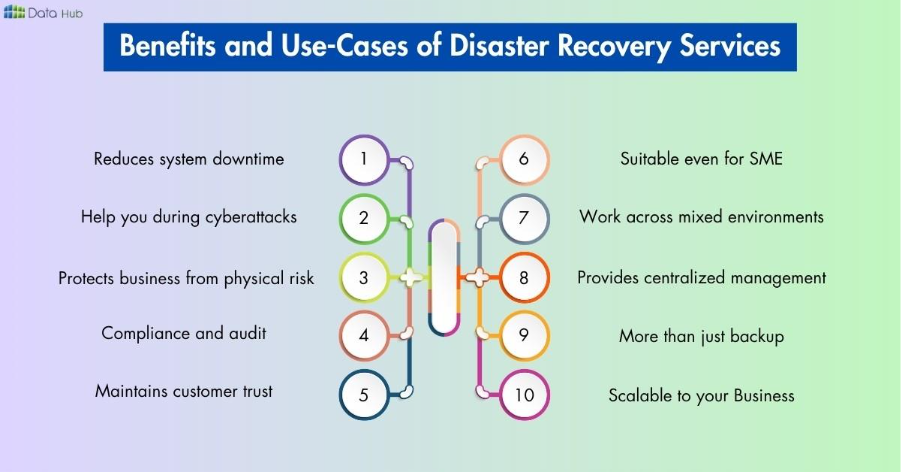
- 1. It Reduces System Downtime
- 2. It Helps you during Ransomware and Cyberattacks
- 3. It protects your Business from the Different Physical Risk Environments
- 4. It helps with Compliance and Audit
- 5. It maintains Customer Trust
- 6. It is useful even for Small and Mid-Sized Businesses
- 7. It works Across Mixed Environments
- 8. It Provides Management with a Better, Centralized Picture
- 9. It is more than just a Backup
- 10. It helps to Enhance Resilience for Critical Sectors
- 11. It is Scalable to your Business
- Why does DRAAS matter more Nowadays?
- Why do Many Businesses trust DataHub for Disaster Recovery in Nepal?
- Conclusion
- FAQs
Benefits and Use-Cases of Disaster Recovery Services for Your Business
1. It Reduces System Downtime
The first and biggest benefit is simple: it helps your business come back faster.
Disaster recovery is based on the recovery time objective (RTO), which is the amount of time your business can remain offline. In some organizations, such as banks, systems may be required back in minutes, while others may tolerate a longer gap.
Think about a Nepali payment company, cooperative, or retail chain that is unable to process transactions for half a day. The loss is not only sales. It also has a huge impact on customer confidence, reconciliation, support workload, and brand image.
In Nepal, where many businesses now depend on digital transactions and cloud applications, even a brief outage can cause prolonged operational disruption.
The point of disaster recovery is to minimize that interruption.
2. It Helps you during Ransomware and Cyberattacks
Cyber risk is no longer limited to large international companies. If a business in Nepal is hit by ransomware, only a local copy of files may not be sufficient.
Datahub Nepal provides cyber resilience, ransomware protection, encryption, and secure recovery design.
A simple example of Nepal: A hospital’s billing server or a school’s student records system is attacked by hackers.
With disaster recovery in place, the business can restore clean systems more safely, reducing the pressure to pay criminals for data restoration.
You may be interested: Things to Consider When Choosing Ransomware Protection in Nepal
3. It protects your Business from the Different Physical Risk Environments
In Nepal, physical disruption is very unpredictable. Earthquakes, floods, fire, civil disruption, and localized infrastructure failures can all affect access to your primary office or server room.
National and international recovery documents on Nepal’s disaster history highlight the severity of these disruptions.
We have already seen how Nepal’s varied disaster histories have affected different business sectors.
This is where disaster recovery becomes practical. If your main office in Kathmandu is inaccessible, a secondary recovery setup outside that location can keep your operations running.
DataHub highlights its dual data centre presence in Kathmandu and Butwal, noting that its Butwal facility serves as a disaster recovery site for some of its cloud services.
That type of geographic separation is helpful in a country where a single local incident can affect a city or site, but the entire business may not be affected.
4. It helps with Compliance and Audit
For regulated sectors, disaster recovery is frequently part of what auditors, boards, and regulators expect to see.
Nepal Rastra Bank’s guidance addresses continuity, recovery, and severe disruption planning, and public explanations of the guidelines focus on board-approved policies, prioritization of critical functions, testing, and recovery processes.
This is one of the big use cases for banks, insurance companies, fintechs, and bigger enterprises in Nepal.
It is not just about passing audits. A written recovery plan, tested systems, and clear back-up architecture demonstrate that the company takes operational risk seriously.
For many growing organizations, the best disaster recovery services in Nepal are those that make this process cleaner and easier to manage, rather than complicate it.
5. It maintains Customer Trust
Customers may overlook a short wait. They are much less forgiving of a company that disappears, loses records, or cannot explain what happened.
Disaster recovery helps businesses maintain continuity in the moments when trust is most fragile.
DataHub helps to ensure minimal downtime and operational resilience during critical events.
Disaster recovery is a strategy to minimize downtime and maintain operational resilience during critical events.
An example from Nepal is an e-commerce seller during the festival season. If order data or stock sync fails for an entire day, the damage is not limited only to that day’s revenue.
Customers can cancel, dispute orders, or switch to another seller. Recovery speed is directly related to reputation in this era of digital technology.
6. It is useful even for Small and Mid-Sized Businesses
Many people still believe that disaster recovery is only for banks or fintech. DRaaS is suitable for businesses of all sizes, with flexible pricing and a scalable design.
In Nepal, this is important for software companies, educational institutions, travel agencies, logistics companies, wholesalers, clinics, accounting offices, and many more.
A small business may not require a massive enterprise setup, but it still needs a reliable way to recover email, files, applications, and customer records.
DRaaS makes that easier because the business does not necessarily always have to build everything on its own.
7. It works Across Mixed Environments
Modern business doesn’t often have everything in one place. Some data resides on office machines, some on virtual machines, some in cloud apps, and some within business applications.
It offers support for multiple data types, databases, applications, operating systems, and hypervisors for its DRaaS, with RPO aligned to business needs.
This is a good use case for Nepali businesses in transition. Many companies have transitioned to the cloud to some extent, but still have critical software that is running on-prem.
Disaster recovery helps consolidate these pieces into a single recovery strategy rather than treating each one separately. In simple terms, it provides the business with a single plan instead of numerous scattered guesses.
8. It Provides Management with a Better, Centralized Picture
A crisis is made worse when no one knows what is backed up, what can be restored, or what the order of priority is.
DataHub particularly mentions centralized management as one of the benefits of DRaaS, enabling teams to manage the availability and continuity from a single interface across on-prem and cloud environments.
That is particularly useful for organizations with small IT teams, which is common in Nepal.
Instead of running around looking for different vendors, devices, and dashboards in an emergency, management can work from a more organized setup. This helps make things respond faster and less chaotically when making decisions.
9. It is more than just a Backup
Many businesses believe that backup and disaster recovery are synonymous. They are not.
Backup is primarily concerned with data copies, while disaster recovery is concerned with the broader plan, systems, and procedures required to restore full operations in the event of a disruptive event.
This difference is important in real life. A business may have yesterday’s backup and still be unable to restore applications, configurations, or services quickly enough to continue serving customers.
Related topics: Difference Between Backup-as a-Service and Disaster Recovery
10. It helps to Enhance Resilience for Critical Sectors
Some sectors just can’t afford to be without power for long. DataHub’s public testimonials include long-term work with institutions such as NIC Asia Laghubitta, Shikhar Insurance, Nepal Life Insurance, and IMS Software in the areas of cloud, co-location, and disaster recovery services.
Nepal’s recent unrest also provided a clear public lesson. Agencies and Institutions with better backup and recovery arrangements were better able to restore services and records.
That is why disaster recovery is especially relevant for sectors that deal with payments, citizen services, medical data, or policy records.
11. It is Scalable to your Business
Disaster recovery is not just about getting through a bad day. It also helps businesses to grow with confidence.
Datahub’s infrastructure is secure, reliable, and scalable, and its service portfolio includes public cloud, private cloud, VPC, backup, security, and DR.
For a growing Nepali business, that can be very important. Maybe today you are running a single-line-of-business application and simple file storage.
Next year, you may add ERP, customer portals, analytics, and remote teams. A good recovery design adapts to that change. It means your continuity plan does not become outdated every time the business grows.
Why does DRAAS matter more Nowadays?
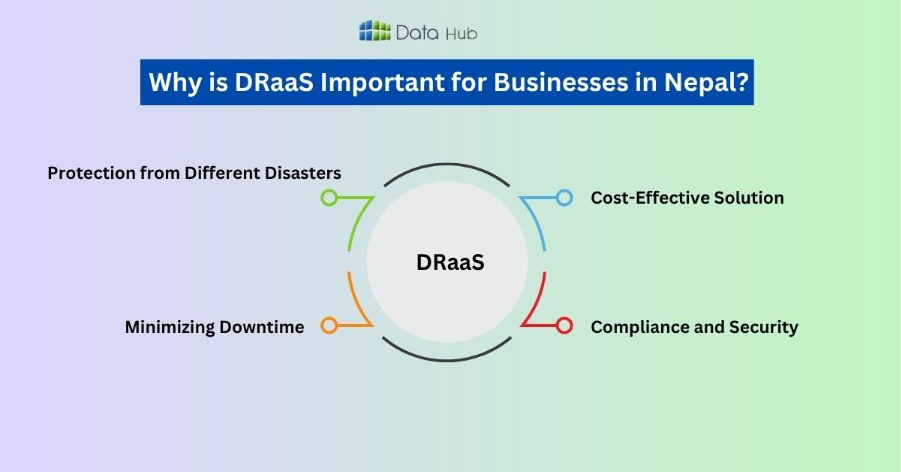
The picture of risks nowadays is greater than before. Businesses are at risk from traditional threats, such as fire, hardware failure, and office disruption, as well as from ransomware, cloud misconfiguration, and dependence on third-party services.
At the same time, customers expect always-on service. DataHub has increased its focus on testing, ransomware protection, local data considerations, recovery speed, and system integration.
For Nepal, there is one more layer: geographic risk, infrastructure variability, and rising digital dependence are all occurring simultaneously. That combination makes disaster recovery less of a luxury for IT and more of a safeguard for your business.
Why do Many Businesses trust DataHub for Disaster Recovery in Nepal?
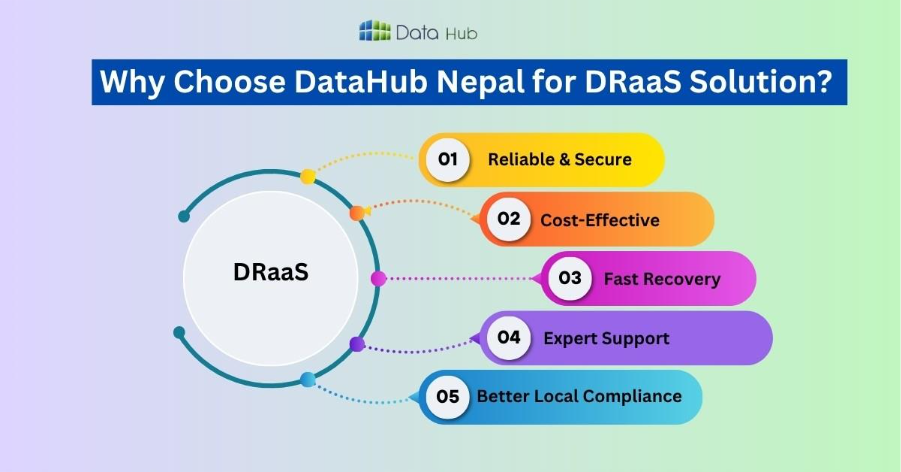
When it comes to disaster recovery, businesses aren’t seeking technology. They want to be reassured. They want to know that if something goes wrong, their systems, data, and operations can be restored with minimum disruption.
This is where DataHub Nepal has a practical edge. As a Nepal-based provider, DataHub understands the realities of Nepali businesses, from infrastructure challenges to the need for reliable local support.
The company has been providing hosting and data centre services since 2012, operates dual data centres in Kathmandu and Butwal, and is ISO/IEC 27001:2013-certified for its security and operational reliability.
For disaster recovery, it offers features such as encrypted data protection, multi-platform support, centralized management, and infrastructure that keeps businesses running even during disruptions.
If businesses are still exploring what matters most before choosing a solution, you can also review these key factors to consider while choosing DRaaS in Nepal.
It is not the technology itself, but the reassurance it provides. For businesses in Nepal, having a provider that combines local expertise with secure, scalable infrastructure can make a real difference when continuity is most important.
That is why many organizations seeking disaster recovery services in Nepal consider DataHub more reliable.
Conclusion
Disaster recovery in Nepal is not just about disasters. It is about normal business life continuing even when something abnormal occurs, preventing a disaster.
A server can stop working. An office can be inaccessible. A cyberattack can make files inaccessible. A local protest can suddenly become a national protest, which can damage lots of infrastructure.
For Nepali businesses, the real value of disaster recovery services is less downtime, less confusion, less loss, and much more confidence.
And for organizations that want the protection under a secure, local, and scalable setup, DataHub Nepal provides an excellent solution for Disaster Recovery as a Services.
FAQs
They are services that can assist businesses in recovering their data, systems, and operations promptly following outages, cyberattacks, or physical disruptions.
The benefits include reducing downtime, protecting important data, and keeping your business running during unexpected problems.
No, small and mid-sized businesses need them too, as even a short outage can result in financial and operational loss.
Backup creates copies of data, and disaster recovery helps restore entire systems and business operations.
Look for security, recovery speed, local support, scalability, and a provider with reliable infrastructure.
Yes, it can help businesses recover clean systems and important data faster after a cyberattack.
