


What would happen if your online store stopped working for 30 minutes during Dashain, a flash sale, or salary day?
Orders would not simply pause. Customers could leave, paid campaigns could keep sending visitors to a broken checkout, and your team could spend the next few hours trying to recover.
IBM cites research putting the average cost of downtime for large organizations at about US $9,000 per minute, although the real figure varies widely by business.
For an e-commerce company, the lesson is simple: e-commerce downtime is not just a technical problem. It can bring problems like in sales, customer-trust, and reputation.
For a Nepali business, the risk becomes more serious during traffic peaks. A promotion can bring hundreds or thousands of visitors at once.
If the application, database, network, or payment flow cannot handle that demand, the store may become slow or unavailable exactly when customers are ready to buy.
DataHub Nepal’s cloud infrastructure combines cloud infrastructure, data centers, backup, disaster recovery, security, and application hosting, giving businesses more than a basic server.
Key highlights
- E-commerce downtime causes lost sales and customer trust.
- Cloud hosting improves availability and handles traffic spikes.
- Load balancing distributes traffic across multiple cloud servers.
- Automated backups enable faster recovery after system failures.
- Disaster recovery protects stores during major infrastructure disruptions.
Table of contents
- Key highlights
- What Is E-Commerce Downtime?
- Why Does E-Commerce Downtime Cost More Than You Think?
- When Is E-Commerce Downtime Most Dangerous?
- Can Cloud Hosting Reduce E-Commerce Downtime?
- How Do You Prevent E-Commerce Downtime During Traffic Spikes?
- What Role Do Data Backups Plays?
- How Does Disaster Recovery Limit the Damage?
- How Important Is Security to E-Commerce Availability?
- What Should Nepali E-Commerce Businesses Look for in a Hosting Provider in Nepal?
- How Can DataHub Nepal Help Reduce E-Commerce Downtime?
- The Bottom Line
- FAQs
What Is E-Commerce Downtime?
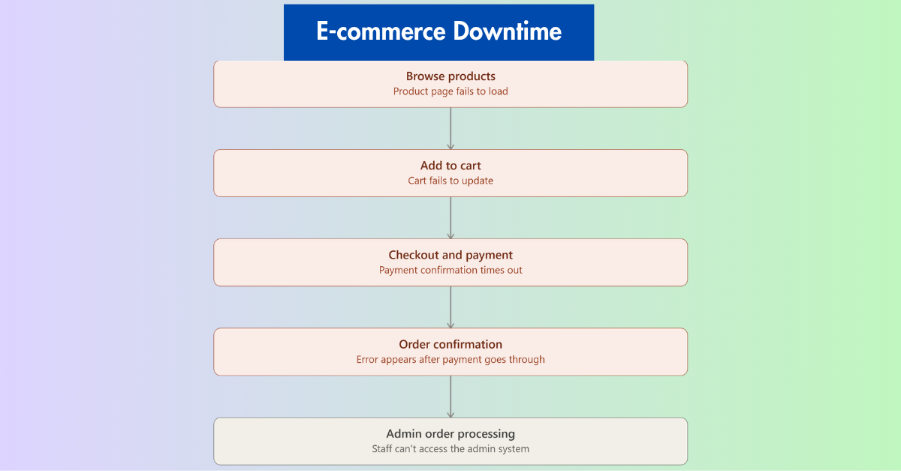
E-commerce downtime is any period when customers cannot use an online store normally. The obvious example is a website that will not open. But the problem can be less visible.
A product page may load, but the cart may fail. Checkout may work, but payment confirmation may time out.
Customers may log in successfully but receive an error when placing an order. Even severe slowdowns can have the same commercial effect because shoppers are unlikely to wait indefinitely.
Measure e-commerce downtime by customer impact, not just whether a server is online. Look at the full buying journey.
Can customers browse products? Add items to a cart? Complete payment? Receive an order confirmation? Can staff access the admin system and process those orders?
Why Does E-Commerce Downtime Cost More Than You Think?
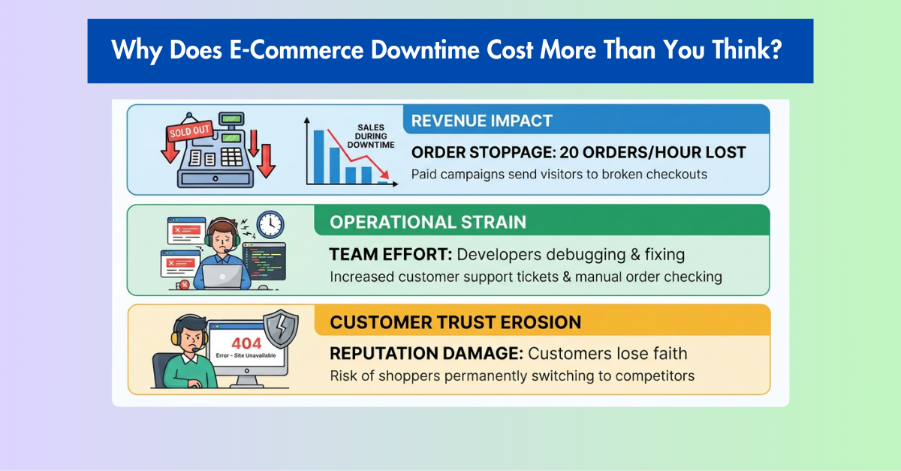
The first expense is lost sales. 20 orders per hour is the usual sales rate for the store, and if the site is unavailable, the opportunity to sell passes.
However, the bill will persist after the site is returned. If you get errors, you might not return right away. If a shopper clicks on a social media ad, goes to a broken checkout, and exits, he or she could purchase from another store. You spent money on marketing and still didn’t convert!
- Lost Direct Sales: Every minute your checkout is broken, active buyers take their money elsewhere.
- Wasted Marketing Budgets: If you are paying for Facebook or Google Ads that lead users to a broken store, you are literally paying for lost traffic.
- Operational Drag: Your engineering team is pulled into emergency firefighting; customer support is flooded with angry messages, and manual refunds or order reconciliations eat up staff hours.
- Permanent Loss of Trust: Customers might forgive a delayed delivery, but repeated checkout failures permanently drive them to competitors.
When Is E-Commerce Downtime Most Dangerous?
Not all downtime has the same commercial impact.
An outage at 3 a.m. may affect fewer customers than one during a Dashain promotion.
Peak-risk periods include:
- Festival campaigns such as Dashain and Tihar
- Flash sales and limited-time discounts
- Payday promotions
- New product launches
- Influencer or social media campaigns
- Large advertising campaigns
- Weekend shopping peaks
This is where e-commerce downtime becomes especially painful. You may have already paid for ads, prepared inventory, hired temporary staff, and planned a promotion. A technical failure can waste the effort behind all of them.
Can Cloud Hosting Reduce E-Commerce Downtime?
Cloud hosting cannot guarantee that an online store will never fail. It can, however, give businesses tools for scaling resources, improving availability, creating backups, and building recovery plans.
DataHub’s public cloud service provides shared cloud infrastructure with snapshot backups, high availability, and a stated 99.95% uptime commitment.
That gives an e-commerce business a stronger starting point than treating hosting as a basic monthly server expense.
For stores with more demanding requirements, a private cloud or virtual private cloud can provide greater resource control and isolation. DataHub’s Virtual Private Cloud includes high availability, redundancy, load balancing, monitoring, and additional resources on demand.
The goal is to match the setup to your traffic, application, data, and recovery requirements.
How Do You Prevent E-Commerce Downtime During Traffic Spikes?
Begin by planning for capacity.
Examine your traffic times: your average traffic and your peak traffic. Then, you can make an estimate of what your next campaign might produce. Never assume, “Well, what if it’s just an average day?
Never think, “What if it’s simply an average day? Preventing outages requires a connected infrastructure strategy rather than a single quick fix:
Plan for Capacity & Load Balancing
Estimate your peak traffic ahead of time. Use IP load balancing to distribute incoming requests across multiple cloud servers rather than overwhelming a single machine.
Leverage a Content Delivery Network (CDN)
Cache static assets like product images and stylesheets locally so your origin server only handles essential dynamic requests.
Implement Automated Backups
Ensure your backup strategy covers customer records, databases, and configuration files, with automated point-in-time restoration capabilities across secure regional centers (such as Kathmandu and Butwal).
Incorporate Disaster Recovery (DR)
Move beyond simple backups. Establish multi-site replication and clear RPO/RTO goals so your store can pivot to secondary workloads instantly if your primary environment fails.
Integrate Web Security (WAF & Firewalls)
Malicious traffic and bot attacks can crash servers just as easily as legitimate shoppers. Protect your infrastructure with integrated firewalls and Web Application Firewalls (WAF).
Resources should be sufficient to meet the anticipated needs and should allow for rapid and unexpected growth. Load balancing can be implemented to share requests between several cloud servers instead of having to load one server with every request.
The Datahub service IP load balancing supports multiple cloud servers. This can be beneficial for a rapidly evolving e-commerce site for a more robust architecture.
Then minimize the amount of additional work that the origin server has to do.
CDN can store and serve content more locally, if it is very commonly requested. Not everything served from the application server is necessarily intended for every visitor: images, static files, and other types of cacheable resources.
DataHub CDN-as-a-Service is designed to reduce load times, save bandwidth, and improve responsiveness for e-commerce and other digital services.
What Role Do Data Backups Plays?
Backups do not prevent every outage. They help you recover when something goes wrong.
Imagine a database problem, accidental deletion, failed update, or other incident affecting your store. Without a reliable backup, recovery can become slow and uncertain.
DataHub Backup-as-a-Service supports scheduled backups, concurrent backups to multiple destinations, and point-in-time restoration. Its backup infrastructure also operates across Kathmandu and Butwal.
For an e-commerce business, backup planning should cover more than product images. Think about customer records, orders, inventory information, databases, application files, and configuration.
Then ask a harder question: How quickly can you restore them?
A backup that exists but takes too long to recover may not meet your business needs.
How Does Disaster Recovery Limit the Damage?
Backups and disaster recovery are related, but they are not the same.
A backup gives you a copy of data. Disaster recovery focuses on getting important systems running again after a serious disruption.
This matters because e-commerce downtime can become much longer when a business has no tested recovery process.
DataHub Disaster Recovery as a Service supports multi-site replication, recovery planning, and RPO/RTO alignment. Its Butwal data center can serve as a secondary recovery location for critical workloads.
That gives businesses a practical way to think beyond “my website is backed up.”
The better question is, “If the primary environment becomes unavailable, how quickly can the store return to normal?”
How Important Is Security to E-Commerce Availability?
Security and availability go hand-in-hand.
An attack can overload an application, adversely affect services, or cause a system to go offline during the investigation of an attack. That can have a negative impact on sales and customer trust for an e-commerce business.
Security must be a component of availability, not just an afterthought after an outage.
DataHub Firewall-as-a-Service and WAF-as-a-Service provide security to infrastructure and web applications.
The information provided on DataHub’s data centers also states that they are ISO/IEC 27001:2013 certified and PCI DSS compliant.
A more robust configuration might include access controls, monitoring, backups, firewalls, application protection, and cloud infrastructure.
What Should Nepali E-Commerce Businesses Look for in a Hosting Provider in Nepal?
Price matters. But it should not be the only comparison point.
Before choosing infrastructure, check:
- Where are the data centers located?
- What uptime commitment is provided?
- How does the provider handle traffic spikes?
- What backup options are available?
- How quickly can systems be restored?
- Is there a secondary recovery location?
- What security services are available?
- Can resources be scaled as sales grow?
- How quickly can you reach technical support?
- Can the infrastructure support your application’s technology stack?
For a business serving mostly Nepali customers, local infrastructure can offer local support and infrastructure closer to the market.
How Can DataHub Nepal Help Reduce E-Commerce Downtime?
The strongest approach is not one product. It is a connected infrastructure plan.
A smaller store may start with the public cloud and scheduled backups. A growing platform may add CDN and stronger security controls. A larger operation may need a VPC or private cloud, multi-site disaster recovery, and additional protection.
DataHub Private Cloud provides dedicated resources and greater control for businesses with more demanding workloads.
DataHub offers this broader stack under one local provider, including public cloud, private cloud, VPC, CDN, backup, disaster recovery, firewall, WAF, and its Yeti Cloud platform.
This matters because e-commerce infrastructure rarely stays static. Your store may start with a few hundred visitors a day and later handle large campaign traffic. Your infrastructure needs to grow with it.
Keep customers shopping, keep orders moving, and give your team a clear recovery path when something goes wrong.
The Bottom Line
There are factors that cannot be eliminated from an online store. You’re able to determine the level of readiness your business will have in the event of a failure.
When ecommerce website downtime happens, orders are lost, advertising isn’t spent, customers are frustrated, support is strained, and it can hurt trust. This is a high-risk time when traffic and customer intent are at their peak.
The solution for Nepali e-commerce companies is not an easy one,that’s buy like buying more hosting. It’s about designing an infrastructure plan based on availability, scaling, backup, security, monitoring and disaster recovery.
All of Datahub’s capabilities dual data centres, local cloud services, data backup and disaster recovery, security products, CDN, and local support are the foundation for that approach.
For the next campaign, review your infrastructure before traffic arrives. Explore DataHub Nepal’s cloud and data-center solutions and choose a setup that fits your application and growth plans.
FAQs
1. What is e-commerce downtime?
E-commerce downtime is a period when an online store or an important part of its shopping journey is unavailable or unusable. It can include complete outages, failed checkouts, payment errors, or severe performance problems.
2. How much can downtime cost an e-commerce business?
There is no single number because the cost depends on traffic, average order value, conversion rate, campaign timing, and business size. Large organizations can face thousands of dollars in losses per minute, while a smaller retailer may experience a lower direct financial impact but still face lost sales and customer trust.
3. How can I reduce e-commerce downtime during Dashain sales?
Start by testing your application under expected peak traffic. Review cloud capacity, database performance, backups, CDN configuration, security controls, monitoring, and disaster recovery. Make sure your recovery process is tested before the campaign begins.
4. Are backups enough to prevent downtime?
No. Backups mainly help restore data. Preventing and minimizing outages also requires reliable infrastructure, monitoring, redundancy, security, and a recovery plan.
5. Is local cloud hosting useful for Nepali e-commerce businesses?
It can be useful when most customers are in Nepal, especially when local infrastructure, support, data-center location, and low-latency access are priorities. The best choice still depends on your application and audience.
