


Key highlights
- Lower Latency for Nepali Users
- 24/7 Local Technical Support
- NPR Billing for Easier Budgeting
- Nepal-Based Data Centers and Disaster Recovery
- Scalable Cloud, Security, and CDN Solutions
Imagine your app is getting a rush of users during a major sale, festival campaign, or a busy business hour. Customers are ready to log in, place an order, pay, or check their account.
But the app takes too long to respond. A few seconds of delay can quickly become a lost customer. With Nepal’s public cloud market already growing, the case for choosing the right infrastructure is becoming harder to ignore.
For businesses building apps primarily for Nepali users, cloud hosting in Nepal offers a practical advantage:
your infrastructure is closer to your customers,
your support team is nearby,
your business does not have to manage every issue across international time zones, etc
Table of contents
- Key highlights
- Why Does Server Location Matter for a Local App?
- Local Hosting vs Hosting Abroad: What Really Changes?
- Benefits of Cloud Hosting in Nepal
- 1. Lower Latency for Nepali Users
- 2. Faster Support When Your App Has a Problem
- 3. Local Billing Makes Budgeting Easier
- 4. Your Business Gets a Local Data-Center Option
- 5. Better Resilience Does Not Mean Keeping Everything in One Place
- 6. Security Can Be Built into the Infrastructure
- 7. You Can Choose Infrastructure Based on Your App
- Why Cloud Hosting Abroad Can Hurt Your Local App?
- Cloud Hosting Migration Checklist
- The Bottom Line: Should Your Local App Be Hosted in Nepal?
- FAQs About Hosting Local Apps in Nepal
Why Does Server Location Matter for a Local App?
When someone opens an app, their request travels between their device and the server hosting the application. The farther that server is from the user, the more network distance the request may have to cover.
That does not mean every overseas server will automatically be slow. Modern networks, caching, and content delivery networks can reduce the effect of distance.
But for apps that constantly exchange information with a server, such as banking platforms, business systems, e-commerce apps, and customer portals, the location of the main infrastructure can still matter.
This is where cloud hosting in Nepal becomes relevant for businesses whose primary users are inside the country. Keeping core infrastructure closer to the audience can reduce unnecessary network travel and make applications more responsive.
DataHub operates two data centers in Kathmandu and Butwal, giving local businesses an infrastructure option inside Nepal rather than requiring every workload to sit overseas.
Local Hosting vs Hosting Abroad: What Really Changes?
The decision is not simply about choosing between a Nepali company and an international provider. It is about how well the infrastructure matches your application’s users, support requirements, and business risks.
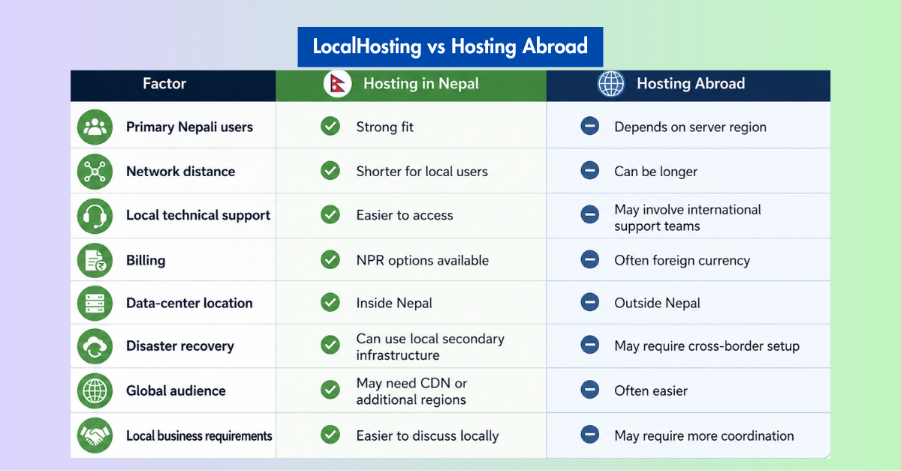
Here is a practical comparison:
| Factor | Hosting in Nepal | Hosting Abroad |
| Primary Nepali users | Strong fit | Depends on server region |
| Network distance | Shorter for local users | Can be longer |
| Local technical support | Easier to access | May involve international support teams |
| Billing | NPR options available | Often foreign currency |
| Data-center location | Inside Nepal | Outside Nepal |
| Disaster recovery | Can use local secondary infrastructure | May require cross-border setup |
| Global audience | May need CDN or additional regions | Often easier |
| Local business requirements | Easier to discuss locally | May require more coordination |
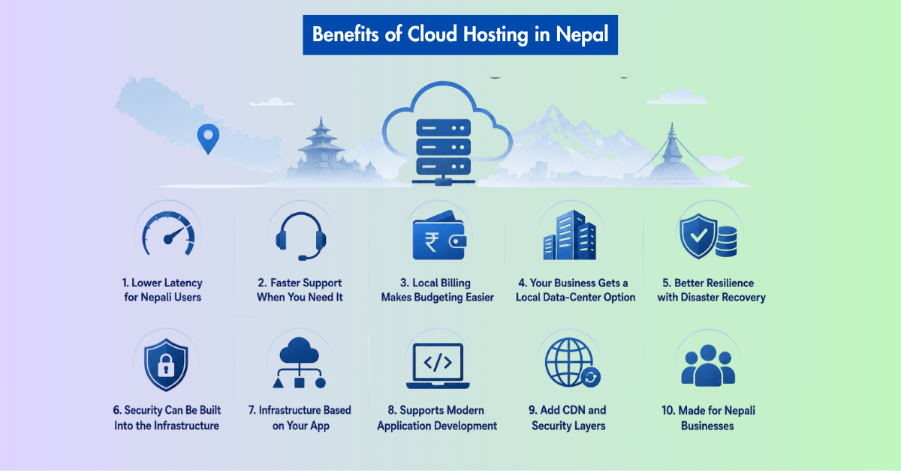
Benefits of Cloud Hosting in Nepal
If Nepal is your main market, the benefits of cloud hosting in Nepal deserve serious consideration before automatically selecting an overseas region.
1. Lower Latency for Nepali Users
Speed is one of the most noticeable benefits.
If your application’s users are mainly in Kathmandu, Pokhara, Butwal, Biratnagar, or other parts of Nepal, hosting critical workloads within Nepal can shorten the network path between users and infrastructure.
DataHub specifically positions its local cloud infrastructure around lower latency for businesses serving Nepali users. Its Yeti Cloud platform is hosted in Nepal and highlights local performance as one of its benefits.
2. Faster Support When Your App Has a Problem
Infrastructure problems rarely arrive at a convenient time.
When the infrastructure provider is based in Nepal, communication becomes simpler. You are not dealing with unfamiliar business hours, international escalation processes, or communication barriers.
DataHub provides 24/7 local support and lists dedicated contact channels for service inquiries and technical support.
3. Local Billing Makes Budgeting Easier
International cloud bills can become complicated.
Businesses may have to deal with foreign currencies, exchange-rate changes, international payment methods, and usage charges that fluctuate from month to month.
4. Your Business Gets a Local Data-Center Option
Data location becomes more important as applications handle more customer and business information.
DataHub operates data centers in Kathmandu and Butwal. Its Kathmandu facility has been operating since 2012, while its Butwal facility has been operating since 2015. DataHub describes the Butwal site as an earthquake-resilient building designed to meet standards for Seismic Zone V.
5. Better Resilience Does Not Mean Keeping Everything in One Place
There is one common misunderstanding about local hosting.
Choosing Nepal does not mean putting everything inside a single server room.
6. Security Can Be Built into the Infrastructure
Hosting locally does not automatically make an application secure. Security still depends on configuration, monitoring, access controls, backups, and protective services.
The advantage is having access to infrastructure designed with business security requirements in mind.
DataHub states that its data centers are certified to ISO/IEC 27001:2013 information security standards. Its cloud portfolio also includes firewall and web application firewall services.
7. You Can Choose Infrastructure Based on Your App
A small business application may need a straightforward public cloud setup. As traffic increases, a growing e-commerce platform might need more resources. For financial or enterprise applications, stronger isolation and control may be required.
DataHub provides several infrastructure options.
Its public cloud infrastructure provides shared cloud infrastructure for businesses.
For organizations looking for additional isolation, the Virtual Private Cloud option provides a single-tenant environment with scalability, privacy, and load-balancing capabilities.
Why Cloud Hosting Abroad Can Hurt Your Local App?
Hosting abroad can make apps slower for Nepali users because data travels farther. It also increases costs due to currency exchange and delays support due to time zone gaps and may cause data privacy issues since foreign servers follow different countries’ laws.
1. Slow Loading Speed
When your server is far away, your app takes more time to load. Data has to travel a long way to reach users in Nepal. This makes pages feel slow, and slow apps can make users leave.
2. High Ping and Lag
“Ping” means how fast data moves between the user and the server. If the server is in another country, the ping is high. This causes lag, especially in apps that need quick action, like games, chats, or payment apps.
3. Expensive in Nepali Rupees
Most foreign hosting companies charge in US dollars. Because of the exchange rate, this can cost more money for Nepali businesses. Local hosting is often cheaper and easier to pay for.
4. Hard to Get Support on Time
If something breaks at night and your host is in another country, you may have to wait many hours for help. Time zone differences make it challenging to talk to their support team quickly.
5. Data Privacy Concerns
Some countries have different rules about user data. If your server is abroad, your users’ data may follow another country’s laws, not Nepal’s. This can be risky for privacy and trust.
6. Currency and Payment Issues
Paying a foreign company often means using international cards or extra payment gateways. This adds more steps and sometimes extra fees.
7. Less Understanding of Local Needs
Foreign hosting companies may not understand Nepal’s internet speed, power cuts, or local traffic patterns. This can lead to problems that local hosts already know how to fix.
Cloud Hosting Migration Checklist
Before migrating, use this checklist to compare hosting providers:
- Server Location: Check where the servers are located and whether the location suits your users in Nepal.
- Redundancy: Understand how the provider handles hardware or infrastructure failures.
- Backups: Confirm how often backups are taken and how long they are retained.
- Support: Check how customer support works and how quickly issues are handled.
- Uptime: Review the provider’s uptime commitment and service-level guarantees.
- Security: Check available security features, including monitoring, access controls, firewalls, and other protections.
- Scalability: Ask how easily you can increase computing, storage, bandwidth, or other resources as your user base grows.
- Nepal Performance: Test your application from Nepal to check latency, loading speed, and overall performance.
- Actual Workload: Choose a hosting plan based on your application’s real traffic, resource needs, and business requirements rather than marketing claims.
For businesses evaluating cloud hosting in Nepal, DataHub offers a broader infrastructure stack that includes cloud infrastructure, data centers, backups, disaster recovery, security, and application hosting.
You Can Add CDN and Security Layers
There is another important point: local hosting and performance optimization are not mutually exclusive.
DataHub’s CDN service is designed to reduce load times, save bandwidth, and improve responsiveness for websites, mobile applications, streaming media, e-commerce, and other digital services.
Security can be layered on top as well. DataHub offers Firewall-as-a-Service and WAF-as-a-Service to help protect infrastructure and web applications.
The Bottom Line: Should Your Local App Be Hosted in Nepal?
If your customers are in Nepal, your infrastructure deserves to be evaluated from their perspective.
A server thousands of kilometers away may still run your application perfectly well. But local infrastructure can offer a combination of shorter network paths, local support, NPR billing, Nepal-based key benefits, and locally accessible disaster recovery options.
For businesses building apps for Nepali customers, that combination can be difficult to ignore.
Cloud hosting in Nepal is therefore less about choosing a flag on a server map and more about choosing a solution that fits your users, risks, and growth plans.
DataHub brings these requirements together through its cloud, data center, backup, disaster recovery, and security services.
If your business is considering moving an existing application or launching a new one, explore DataHub Nepal’s cloud infrastructure and compare the setup with your application’s actual needs before making the move.
FAQs About Hosting Local Apps in Nepal
1. Is hosting in Nepal faster for Nepali users?
It can be, particularly when the application communicates frequently with its origin server. A shorter network path can reduce latency, although application kilometer caching, internet routing, and CDN configuration also affect real-world performance.
2. Is local hosting more secure than foreign hosting?
Not automatically. Security depends on infrastructure, configuration, monitoring, access control, backups, and security practices. DataHub’s infrastructure includes ISO/IEC 27001:2013-certified data centers and additional security services.
3. Can startups use cloud hosting in Nepal?
Yes. Startups can choose smaller infrastructure and increase resources as their app gains users. DataHub’s Yeti Cloud also uses pay-per-usage billing, which can help businesses avoid paying for capacity they do not currently need.
4. Can I host an application in Nepal and still serve international users?
Yes. Hosting an application on a server in Nepal does not prevent international users from accessing it. Businesses can also use CDN services to improve content delivery and reduce latency for users in different locations around the world.
5. What if my Nepal-based key application needs disaster recovery?
A disaster recovery setup should use separate infrastructure and a tested recovery process. DataHub provides disaster recovery and multi-site replication options using its infrastructure.
