


VPS services differ from one another. And in Nepal, where companies entrust their digital operations to their hosting provider, choosing the wrong one can be a risk to the organization.
There are plenty of choices on the market with features such as NVMe SSDs, 99.9% uptime, root access, and scalable resources.
After you do some research, all the pages start to sound the same. So, how do you really know which providers will actually deliver?
There are specific signs you need to look for to determine the quality of a VPS hosting service provider and whether they’re a performance-focused, secure service or just a nice-looking pricing page.
Learn more: How Can VPS Hosting Boost Your Website Speed and Performance in Nepal?
Table of contents
- Signs of secure and high-speed VPS hosting
- 1) NVMe Storage, Not Just SSD
- 2) Guaranteed Uptime
- 3) Data Center Located in Nepal
- 4) DDoS Protection should be Standard
- 5) Full Root Access
- 6) High Availability Architecture with a Backup
- 7) Proper ISO Certification
- 8) Layered Security Services
- 9) Quick Backup and Recovery Work
- 10) Scalability Without Migration
- 11) Local Support That Is Reachable Around the Clock
- Conclusion
Signs of secure and high-speed VPS hosting
1) NVMe Storage, Not Just SSD
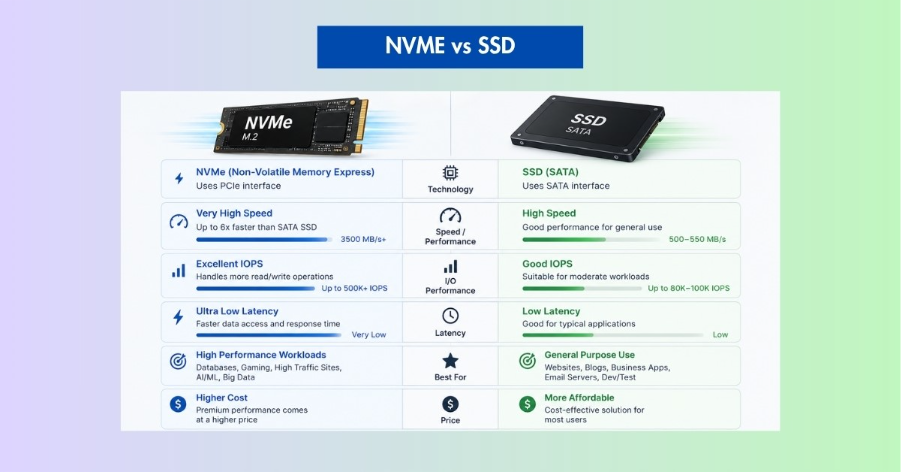
This one is a common error. The term SSD has become so widely used in hosting marketing. The difference between a standard SATA SSD and an NVMe SSD is significant and affects application responsiveness.
Unlike SATA drives, NVMe drives do not use the PCIe interface and are directly attached to the CPU, which removes the SATA bottleneck.
The result achieved is several times faster reading and writing. This isn’t a small difference for databases, e-commerce platforms, or applications that frequently use files.
When comparing VPS web hosting in Nepal, be sure to inquire about the type of storage the web server supports. If the answer is NVMe, then that’s a good indication of the quality of the infrastructure. If the response is unclear, it’s a clue as well.
All DataHub Nepal’s Public Cloud VPS plans come with NVMe SSD storage, starting from the small plan at Rs. 1000 per month.
2) Guaranteed Uptime
All providers boast about their high uptime. The question is, do they provide a number during the agreement?
99.95% uptime means there is less than 4.5 hours of downtime per year. A commitment that makes sense for a business that relies on its website, customer portal, or app being available 24 hours a day, seven days a week.
A high availability that isn’t backed by a specific number is worthless when your site is down during a traffic surge.
The risks are very real for Nepal’s businesses. Those who are unable to visit payment gateways or e-commerce shops during Dashain and Tihar, don’t wait around. They move on.
So, check whether they provide a written guarantee of uptime rather than a marketing promise.
3) Data Center Located in Nepal
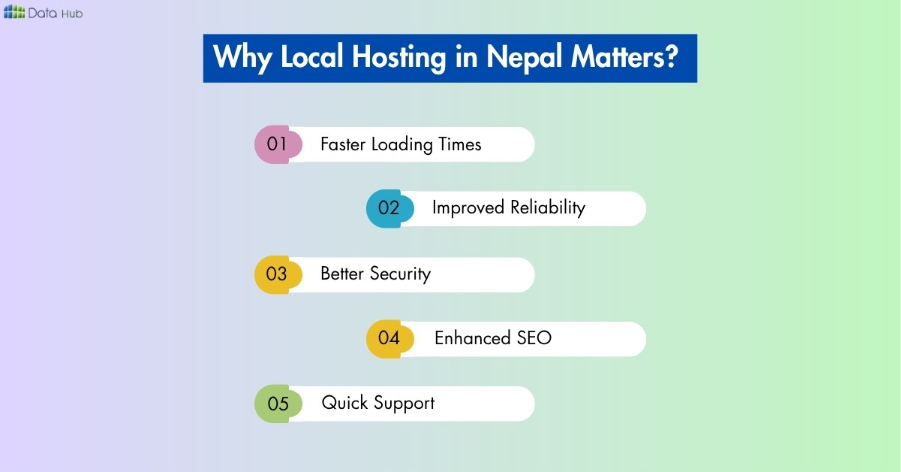
This is not as obvious as it sounds. If your server is in Singapore, India, or any country other than Nepal, each time your visitors access your website, they have to cross the Nepalese border twice.
That adds latency. It might be a few milliseconds for a single page, but when you add up all of the pages that a modern web page loads, it really adds up. That’s why high-speed VPS hosting in Nepal is very important.
The speed of your website has a direct impact on the length of time visitors spend on your site, whether they go on to make a purchase, and how search engines rank your pages.
The blog on the importance of website speed for Nepali businesses explains the real consequences businesses face due to a slow experience.
A VPS hosted within the nation will serve local users faster. No cross-country travel is required. Processing, serving, and returning the data from within the country.
DataHub has two certified DataCenters, one in Kathmandu and one in Butwal, Nepal. One of the most obvious indicators that a provider is truly geared toward the Nepali market.
You may find it useful: 13 Things to Consider When Choosing the Best Data Center Service in Nepal (2026)
4) DDoS Protection should be Standard
DDoS attacks are not uncommon for large international corporations. They have happened to businesses in Nepal as well, especially in the fintech, e-commerce, and media sectors.
An attacker overwhelms your server with traffic until it can no longer handle it, causing your site to go down.
If the hosting company is going to charge you extra for DDoS protection, that’s a sign of how they see their duty towards you.
Network-level protection should be part of your VPS, not an add-on on an upgrade page.
DDoS is a standard feature on all cloud VPS plans available in DataHub Nepal. It’s not just a high-end feature.
5) Full Root Access
A VPS can only be as useful as the control that it provides. If a provider only lets you install certain software, changes how your server environment is configured, or enables only certain services, then you’re really using managed shared hosting named as VPS.
Having full root access allows you to choose which software is installed on your server. Your firewall rules are set by you.
The packages that your application needs are installed. You can configure the operating system to be optimal for your workload. You don’t have to wait in a queue to have basic configuration changes made.
Root access is a minimum requirement for development teams, agencies that manage their clients’ infrastructure, or businesses deploying custom applications. A good VPS provider in Nepal should provide it for free.
6) High Availability Architecture with a Backup
One data center, no matter how well it’s run, is a single point of failure. Even with redundancy at one location, unexpected outages can occur due to a variety of conditions, such as floods, power outages, hardware failures, and physical incidents.
High availability architecture is when your workload continues to run in the event of a problem at the primary site. It needs a secondary location, data duplication, and failover processes.
In industries where non-stop operations are a must, it is a difference between a small incident and a serious operational crisis.
This is taken into account in DataHub’s infrastructure. The Butwal data center serves as a DR site for operations in Kathmandu, and the Disaster Recovery service enables businesses to replicate their critical systems to quickly resume normal operations in the event of a disruption.
7) Proper ISO Certification
Secure infrastructure can be easily written on a webpage or in ads.
The ISO/IEC 27001:2013 certificate assures that information security practices comply with a globally accepted standard, that documented processes are actually implemented, and that a third-party audit has verified the security management systems.
For some businesses, like banks, insurance and health care providers, and government services, this certification is a legal requirement. For everyone else, it’s a great sign that security claims are legit.
DataHub Nepal’s Data Centers are ISO/IEC 27001:2013 Certified. One reason organizations such as NMB Bank, Global IME Bank, Nepal Life Insurance, and Shikhar Insurance trust the infrastructure is this certification.
8) Layered Security Services
It’s not just about the server. It’s about the secure VPS hosting environment. All the connections between your systems, the web application layer, and the network around the server must be protected.
You should look for:
Network-level security with a dedicated Firewall as a Service that filters out malicious traffic before it reaches your infrastructure, without needing to buy and maintain physical appliances.
Application-level protection with a WAF as a Service is deployed between your web applications and the internet to prevent injection attacks, cross-site scripting, and other web-based attacks.
Malware protection to detect and block malware that can enter via various means.
These are not products to source from various vendors. With DataHub, they provide integrated security services that complement the VPS infrastructure.
The integration is significant because the gaps where threats are likely to leak in are between the various tools that are not closely integrated.
9) Quick Backup and Recovery Work
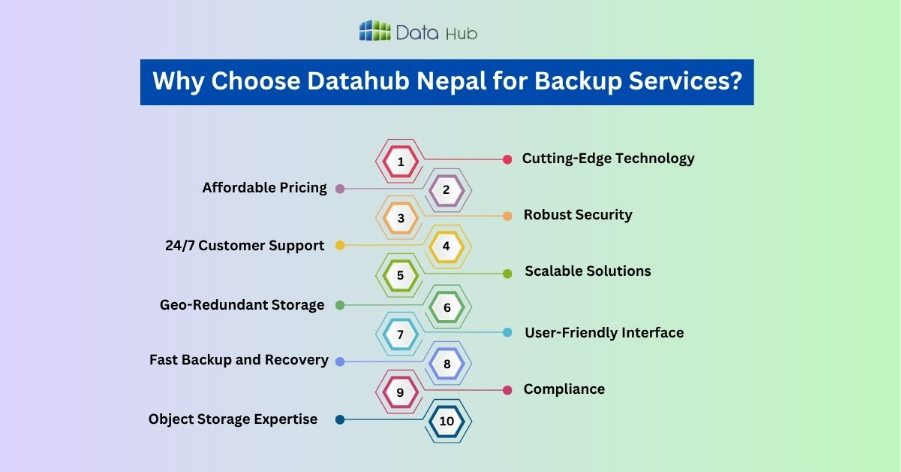
If you ask any Nepal business owner who has experienced data loss, what they wish they had done differently. The answer is nearly always one of the following: Better backups and testing them
A good VPS hosting company doesn’t leave backup management entirely on you. You should have a way to schedule snapshots, automate your server’s backup, and restore it to a known working state, all of which should be available, documented, and reliable.
Backup as a Service offers highly redundant, disk-based backup solutions with scheduled image snapshots. You can restore backups to your live server and retrieve your data whenever you need it, instead of working out the details of manually backed-up data.
It’s here that businesses with multi-system environments really benefit from the Virtual Private Cloud service.
It also comes with real-time traffic monitoring and logging, providing you with visibility into what’s happening in your environment, rather than only when customers start complaining.
10) Scalability Without Migration
Growth is the goal of every organization. However, the last thing you want to find out is that your host doesn’t offer the scalability you need when you need it most.
Having to switch to a new server, plan for it, and deal with the downtime, every time you outgrow your plan is exactly the time you should be making the most of your business success.
Real scalability is the ability to add vCores, RAM, and Storage within the current environment. The resources you add, your environment responds, and your application continues to run. No migration window. No downtime.
That’s what cloud-native VPS infrastructure is meant to offer, and that’s what sets a good cloud provider apart from a cloud company that has simply rebranded its old dedicated server offerings.
This is where cloud data architecture comes into play with DataHub. Resources can be added to the workload when it increases. If a project is over and you don’t need as much, you reduce the scale.
If you want more flexibility in how your infrastructure is managed, Yeti Cloud offers even more with a pay-per-usage PaaS model that scales the platform in proportion to your actual consumption and charges you for what you use.
11) Local Support That Is Reachable Around the Clock
This is the sign that makes good infrastructure great. But if something goes wrong at 2 am, just before the product goes to market, the hosting quality will be judged solely by the response time and understanding of the situation.
A support team located in a different time zone, who have to follow a ticketing system to a problem occurring in Kathmandu at this very moment, isn’t the same as a local team on the phone in Kathmandu.
Communication and understanding context matter. It is important to understand what could have influenced a problem due to load-shedding or connectivity issues specific to the Nepali context.
DataHub Nepal is available locally 24/7 via phone, email, Viber, and WhatsApp. Clients from a wide range of industries have been hearing about it locally as one of the key factors they are sticking around for.
Shikhar Insurance said they found the process easier because they had 24/7 support and received consistent responses. One of the reasons they are happy with the company after years of association is its customer support, said NIC Asia Laghubitta.
Conclusion
As you read through all the signs, you will see a whole picture. There is no single feature that determines the best secure and high-speed VPS hosting in Nepal.
The depth and consistency of all of them are what’s important. Things like NVMe storage, guaranteed uptime, in-country servers, DDoS protection, ISO certification, firewall and WAF coverage, automated backups, real scalability, and truly responsive local support.
A provider that’s strong in all of these is a partner with your business, not just a provider.
When you’re choosing between RDP and VPS hosting, it’s best to understand how they differ before you make your decision.
This infrastructure has been operated by DataHub Nepal for the benefit of Nepali businesses since 2012.
Over 1,000 institutions, including the leading banks, insurance firms, fintech companies, and media outlets in Nepal, have made the same evaluation and reached the same conclusion.
If your current hosting does not meet these standards, or you are looking for the best secure VPS hosting plan in Nepal, meeting these standards has never been this easy.
Compare DataHub’s VPS Plans or connect with the DataHub Team directly and select the best plan for your company.
