
Nepal’s digital economy is growing at a fast pace, and cloud-based infrastructure is being adopted by businesses as a top choice to stay competitive.
A statistic by Statista Market Insights about Nepal’s public cloud market shows that by 2025 it will have a revenue of US $138. 76 million and have an annual growth rate of 22.8 percent which may lead to US $387. 57 million.
Traditional hosting has the disadvantage of breaking down when it comes to sudden traffic surges and the need for other resources making it slower and more expensive.
Cloud hosting is the way to go as it offers scalability at the snap of the fingers, regular uptime, and better security.
The only Nepalese provider that can offer dual data centers in Kathmandu and Butwal with the lightning-fast and low-latency local performance for businesses is DataHub Nepal.
Bringing together world-class infrastructure and local knowledge. One of the most dependable and effective cloud hosting solutions in Nepal is provided by DataHub Nepal.
Table of contents
- The Basics of Cloud Hosting: Why It Matters for Success?
- Choosing the Right Cloud Hosting Category for Your Business Needs
- Why Cloud Hosting Is Better Than Traditional Shared Web Hosting?
- 8 Reasons Why Nepal Businesses Should opt for Cloud Hosting
- How Much Does Cloud Hosting Cost in Nepal?
- VPS vs. RDP: Which Hosting Solution Is Right for Your Work?
- Who Needs Cloud Hosting? Identifying the Best Users in Nepal
- DataHub Nepal’s Cloud Infrastructure: What Sets It Apart?
- Conclusion
The Basics of Cloud Hosting: Why It Matters for Success?
Cloud hosting is a new methodology for web hosting where the location of websites, applications, and databases is distributed over numerous, networked servers instead of one single server.
Automatic handing over of the tasks to the other servers happens without any interruption of the performance level, and the user will not experience any problem. Unlike traditional hosting, cloud hosting dynamically adapts to changes in traffic and resource requirements.
In addition to allowing businesses to adjust their CPU, RAM, and storage in real time.
Cloud hosting also offers high availability, enterprise-level security, and redundancy, which is why it is well suited to startups, small and medium businesses, and large enterprises.
Here is a detailed guide about cloud hosting that will help you understand the advantages of cloud hosting, its architecture, and provide you with examples.
Choosing the Right Cloud Hosting Category for Your Business Needs
When you look for cloud hosting in Nepal, you can find several exclusive models that a business can choose according to the infrastructure needs.
Understanding these models will enable you to select the best model based on your workload, compliance, and financial considerations.
1. Public Cloud Hosting
With public cloud hosting, you get access to virtualized computing resources which are shared physically with other customers but isolated logically for the purpose of security and performance.
This type of cloud hosting is very scalable, has a simple and clear pricing structure, and you can get your resources quickly which is why it is a good match for websites, apps, or small and medium-sized enterprises that want cost-efficient cloud servers in Nepal.
With the pay-as-you-grow model of DataHub Nepal’s public cloud offering, there is no capital investment upfront when you increase the amount of resources you need.
2. Private Cloud
With private cloud hosting, a cloud environment is dedicated, and only one single organization will have access to it.
This separation makes it possible to have more control, security, and compliance levels which are necessary for companies like financial services, insurance, or very large enterprises that have sensitive data.
DataHub Nepal’s Private Cloud allows organizations to design their cloud environment according to their regulatory and performance needs without sharing their infrastructure with other tenants.
3. Virtual Private Cloud (VPC)
A VPC is where public and private clouds are mixed in the best way. It permits you to have a network, which is logically isolated within a public cloud, gives you both the freedom of a public cloud and security like that of a private one.
On-premises systems connected to cloud environments, with the requirement of network segmentation, are the deciding factors for most businesses in their choosing this model.
Hybrid cloud deployments are made easy and secure by DataHub’s Virtual Private Cloud (VPC) products.
4. Platform as a Service (PaaS)
Developing applications without the hassle of server or middleware management is possible with the help of Platform as a Service (PaaS).
Developers can deploy, test, and scale apps with the least effort and maximum automation through DataHub’s Yeti Cloud, which provides them with the flexibility to concentrate on innovation rather than the infrastructure.
Why Cloud Hosting Is Better Than Traditional Shared Web Hosting?
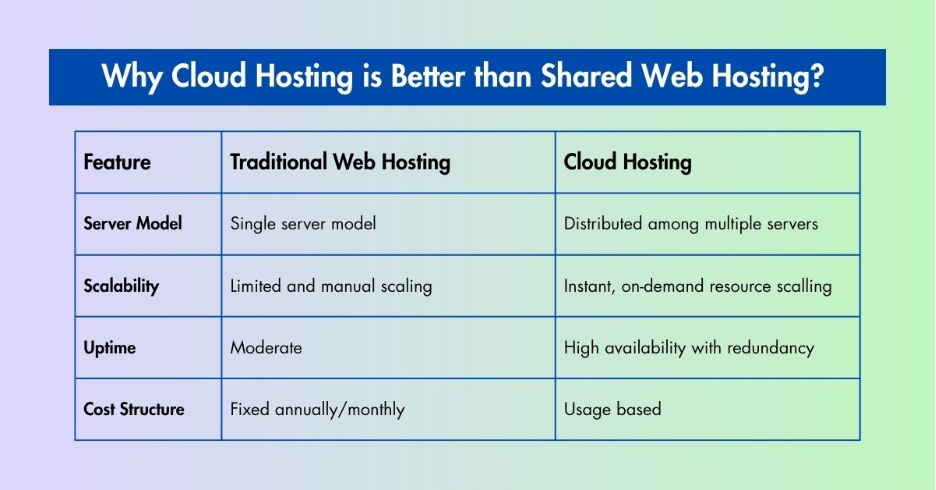
Cloud hosting and traditional web hosting both make websites available online, but they are very different in terms of architecture, flexibility, and performance.
Let’s do a quick comparison between a few major reasons that make cloud hosting the primarily choice of businesses in Nepal that want to grow:
Modern business applications require resilience. If you have been a user of a traditional web hosting service, maybe you should check out this comparative article on what a web hosting service is, where you can get to know the differences more deeply.
8 Reasons Why Nepal Businesses Should opt for Cloud Hosting
Cloud hosting in Nepal can provide you with several extra benefits that traditional hosting cannot. These are benefits that make the most sense considering the country’s market situation, internet usage, and legal environment:
1. Low Latency for Local Users:
Hosting infrastructure within Nepal allows businesses to provide faster loading times for local users than if they were dependent on foreign systems.
Shortening the distance latency not only enhances the user experience but also results in faster page responses and ultimately a better ranking in search engines.
2. Scalability on Demand
These days, using cloud resources is much more effective for managing seasonal changes in traffic or special campaign days. This is because of the incredible flexibility of the cloud, not only in scaling resources up or down but also in doing so without any hardware changes.
3. Local Currency Billing
Cloud hosting service providers such as DataHub allow customers to be charged in Nepali Rupees (NPR), thereby removing the issues with foreign exchange and sudden charges due to currency fluctuation that are usually faced with international providers.
4. Regulatory Compliance and Data Residency
Maintaining data within Nepal’s jurisdiction is a straightforward approach to compliance for the banking or fintech business by the regulators like the Nepal Rastra Bank or the Financial Information Regulations.
5. Reliable Uptime Guarantees
Redundant server clusters which are found on cloud platforms can keep a service running even if some hardware failure occurs, which is a key factor for the continuity of critical systems.
6. Improved Security Posture
Top cloud providers give business-level security controls such as firewalls, web application firewalls (WAF), anti-malware, and intrusion protection to protect business resources. DataHub’s security features also extend these protections at multiple layers.
7. Disaster Recovery and Backup Assurance
Even in the face of hardware failure or natural calamities, businesses can still operate and be productive with the help of Backup-as-a-Service and Disaster Recovery Service.
8. Cost Efficiency over Time
The cloud hosting service model is especially appealing as it effectively combines the pay-as-you-go principle with the elimination of massive equipment investments.
This approach not only prevents you from making large upfront capital expenditures but also provides flexibility to startups and small and medium enterprises, who are typically thinking about increasing their capabilities gradually.
How Much Does Cloud Hosting Cost in Nepal?
The cost of cloud hosting in Nepal is not fixed and depends on various factors such as performance storage support, and the capability of providers.
Price Determining Factors:
- Resource Allocation: The monthly costs depend on the choice of CPU memory storage and bandwidth.
- Support Level: The availability of 24/7 local support and SLA commitments may affect the prices.
- Service Add‑Ons: Additional security services such as WAF‑as‑a‑Service and Firewall‑as‑a‑Service might be charged separately.
- Disaster Recovery Features: Backup and DR services provide extra protection but may increase the overall cost if selected.
Here is an example of pricing for DataHub Nepal, a market leader in this domain:
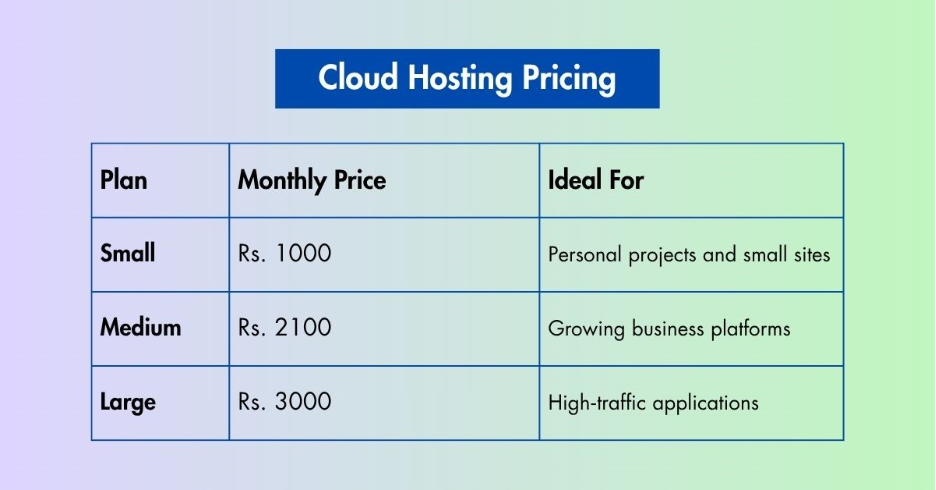
Such pricing levels depict how cloud hosting Nepal price points can be varied according to business needs and whether advanced functionalities or managed services are included.
VPS vs. RDP: Which Hosting Solution Is Right for Your Work?
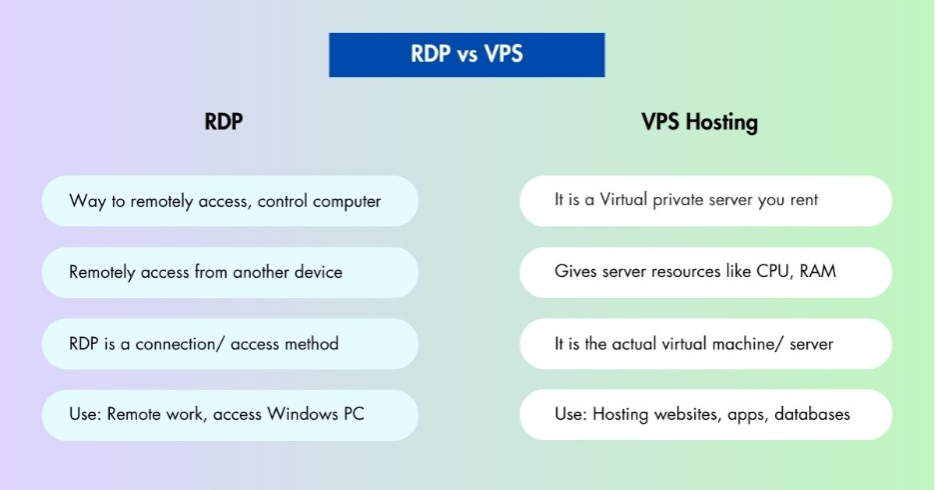
Cloud users frequently weigh up VPS (Virtual Private Server) hosting and RDP (Remote Desktop Protocol) hosting. Each one is designed for a very specific purpose:
VPS Hosting (Cloud Server Nepal)
A VPS dedicates an area in the cloud environment with specific resources and offers the administrator total control over it.
This environment is perfect for developers, applications, and websites needing the complete range of configuration options, new software installations, and the capability of growing the infrastructure.
DataHub Nepal’s VPS offers, root access, use of premium NVMe SSD storage, and outstanding network performance comparable to that of an enterprise-grade environment.
RDP Hosting
In RDP hosting, a user can interact with a remote desktop environment. That is, a logged-in session on a Windows server, which is pre-set with specific software and accessible by the user.
This method is best suited for users who are comfortable with the desktop environment and need it for specific purposes, but who don’t require server-level access or customization.
If you want an in-depth comparison and help in selecting the right hosting type for you, you will find the RDP vs. VPS hosting guide very insightful and educational.
Who Needs Cloud Hosting? Identifying the Best Users in Nepal
Though cloud hosting is beneficial for a wide variety of businesses, its biggest impact is felt by following segments:
- Startups & Tech Companies: They will use cloud environments as an effective tool for scaling up and rapid development.
- E‑Commerce & Online Retailers: Their main requirement is high availability, security, and handling traffic irregularities.
- Financial Services & Fintech: They face some limitations when it comes to meeting the regulatory standards and at the same time it is performance which remains the biggest challenge.
- Educational Platforms: They benefit from flexible resources especially when it is peak time of the semester, online exams, etc.
- Media & Content Platforms: The required cloud hosting for scalable storage will increase their delivery performance in the face of rising viewers.
- Healthcare & Clinics: Patient data, being highly sensitive, will benefit secure, hosting compliant setups.
Basically, any one of the businesses that is planning a scale up or those which are in constant need of reliable digital infrastructure should definitely opt for cloud hosting in their expansion plan.
DataHub Nepal’s Cloud Infrastructure: What Sets It Apart?
DataHub Nepal, being one of the most reliable cloud hosting providers in Nepal, facilitates digital infrastructure for a range of prominent organizations.
Among the prominent clients are Fonepay, Khalti, NMB Bank, Global IME Bank, Shikhar Insurance, Nepal Life Insurance, Yeti Airlines, and Merojob, which collectively illustrate the platform’s capability to deliver enterprise grade performance and reliability.
The platform of DataHub Nepal is built on globally standardized, carrier neutral data centers in Kathmandu and Butwal, which provide low latency, redundant connectivity, and have disaster recovery capabilities.
Since DataHub is physically present in the country, it allows for billing in NPR, helps with compliant adherence to Nepali data regulations, and provides support 24/7 tailored to local markets.
This level of localization guarantees that enterprises get to run their operations safely and if needed, scale without having to pay exorbitant prices for foreign cloud solutions.
Besides that, the company offers a variety of security features including the Web Application Firewall (WAF‑as‑a‑Service), Firewall‑as‑a‑Service, and malware protection solutions, thereby ensuring that workloads are protected on various levels.
Combined with backup and disaster recovery services such as Backup‑as‑a‑Service and DR‑as‑a‑Service.
DataHub supplies an all-encompassing cloud environment that is built to secure data and support continuous job performance even when things go wrong.
Conclusion
When a business is considering cloud hosting Nepal, the selection of a good service provider would surely influence the changes in business significantly performance, scalability, and security.
Offering reasonable prices, powerful locally based data centers, and a great amount of expertise along with enterprise adoption that is trusted.
The first and foremost choice in this regard is DataHub Nepal which keeps on being a popular option among organizations that want to take their digital services to the next level.
If you want to change your business through cloud-based solutions that are scalable, secure, and dependable, contact DataHub Nepal right away and see the ways in which their cloud offerings can lead to the growth and resilience of your business.
