
What if your next software launch succeeds but your hosting becomes the bottleneck?
That is the uncomfortable question more Nepali businesses are beginning to face as applications become more demanding and customers expect faster, always-available digital services.
The global PaaS market was valued at an estimated $167.93 billion in 2025 and is projected to reach $196.65 billion in 2026, showing just how quickly businesses are embracing managed application platforms. ( Source:fortunebusinessinsight blog)
If you are wondering What is PaaS and whether it has a practical place in your business, DataHub Nepal’s Yeti Cloud platform offers a locally hosted, managed PaaS environment designed to make application deployment and scaling easier.
Table of contents
- What Is PaaS?
- How Does PaaS Work?
- Traditional Hosting vs PaaS: What Changes?
- Why Are Businesses Moving Beyond Traditional Hosting?
- 5 Reasons Nepali Businesses Should Consider PaaS
- Is PaaS Better Than VPS Hosting?
- Is PaaS Suitable for Small Businesses and Startups?
- What About Security and Business Continuity?
- When Should Your Business Move to PaaS?
- How to Choose the Right PaaS Provider in Nepal?
- The Bottom Line for Nepali Businesses
- Frequently Asked Questions
What Is PaaS?
A Platform as a Service, which is full form of PaaS, is one form of cloud computing service model. It offers a versatile and scalable cloud computing platform for the creation, deployment, execution, and management of applications.
PaaS gives all the necessary services to developers to build their applications without any trouble related to operating system, development tools, or hardware updates. Rather, the whole platform is provided to the developer through cloud computing.
How Does PaaS Work?
What is PaaS can be best understood through the process between coding an application and delivering to users.These various steps are included to how paas actually works.
Step1: Development Phase
PaaS provides a framework for deploying and running the application. Rather than having to manually configure every element of the infrastructure, this is done automatically for you to some extent.
Step2: Deployment and running the application
Let’s say there is a software company in Kathmandu that needs to develop a booking app. This involves creating user accounts, the booking process, notifications and payment functionality. The developers don’t need to be spending a week setting up servers and dealing with operating system issues.
Step3: Deliver the app and make it live to public
DataHub Nepal’s managed application hosting solution is comprised of automated containers, deployment tools, monitoring and configurable alerts. And also supports technology stacks such as Python, Java, PHP, Node.js, Go and Ruby.
This is how it becomes easy to go from development to production for the application.
Traditional Hosting vs PaaS: What Changes?
Here is the biggest difference.
Traditional hosting gives you a place to run your application.
PaaS gives you a managed environment built around running applications.
With a conventional server, your team may be responsible for installing software, configuring the environment, applying updates and planning how to scale.
With PaaS, many of those responsibilities move to the platform provider.
That does not mean your developers lose control of the application. They still own the code, functionality and business logic.
They simply spend less time dealing with the infrastructure underneath it.
If you are still asking What is PaaS compared with ordinary cloud hosting, this is the practical distinction: PaaS sits at a higher level of management. It is designed around the application rather than just the server.
DataHub also provides cloud VPS hosting, which may be a better fit for businesses that want greater server-level control. The right choice depends on how much infrastructure management your team wants to handle.
Why Are Businesses Moving Beyond Traditional Hosting?
Traditional hosting is not automatically bad.
It can be perfectly suitable for a straightforward website or application with stable requirements.
The problem starts when the business becomes more demanding.
Your application gets more users. Releases become more frequent. Integrations increase. Traffic becomes less predictable. Your development team grows.
Suddenly, infrastructure management starts taking up valuable time.
That is when What is PaaS becomes a more practical business question than a purely technical one.
PaaS can help reduce the amount of routine infrastructure work involved in deploying and operating applications. Atlassian notes that PaaS can support faster development, testing and deployment by reducing the infrastructure responsibilities traditionally handled by development teams.
For a growing Nepali software company, that can mean fewer hours spent maintaining the environment and more time spent improving the product.
5 Reasons Nepali Businesses Should Consider PaaS
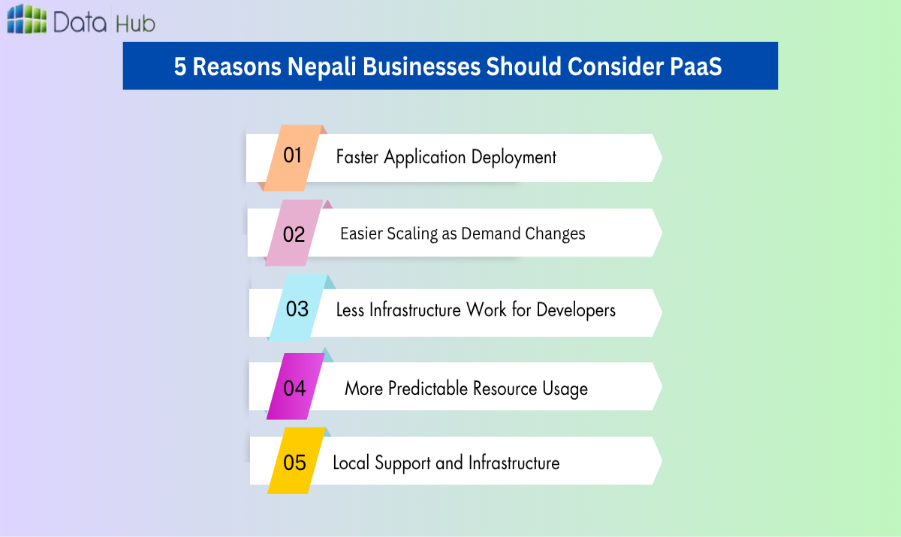
1. Faster Application Deployment
Every day spent preparing infrastructure is another day before customers can use your application.
PaaS streamlines the route from development to deployment.
DataHub’s Yeti Cloud deployment environment supports deployments through Git, SVN, FTP and SFTP, as well as CI/CD workflows. That gives development teams several practical ways to move applications into production.
For startups working toward a launch date, speed can be a competitive advantage.
2. Easier Scaling as Demand Changes
Your application may have 500 users today.
Next year, it could have 50,000.
Traditional infrastructure can require careful capacity planning whenever usage changes significantly.
PaaS is built around a more flexible approach.
DataHub’s Yeti Cloud provides automated vertical and horizontal scaling, along with automated traffic distribution and load balancing.
That makes What is PaaS particularly relevant for businesses whose workload is expected to change as they grow.
You do not want your infrastructure to become the ceiling on your success.
3. Less Infrastructure Work for Developers
Your developers were hired to build software.
Not to spend every afternoon dealing with server maintenance.
A managed platform can take care of a larger portion of the underlying environment, allowing developers to concentrate on application functionality and customer-facing improvements.
That does not eliminate technical responsibilities.
It simply moves routine infrastructure management to a platform designed to handle it.
4. More Predictable Resource Usage
One major attraction of cloud platforms is flexibility around resource consumption.
Instead of purchasing hardware upfront, businesses can use cloud resources according to their needs.
DataHub’s pay-per-usage cloud model lets users set resource limits and pay according to usage. Billing in Nepalese rupees can also remove some of the complications associated with foreign-currency payments.
For startups and growing businesses, this can make budgeting easier.
You can put more money into product development instead of buying infrastructure before you actually need it.
5. Local Support and Infrastructure
Here is where the Nepal angle becomes important.
A global cloud platform may offer impressive technology, but a local provider can offer something equally practical: local support, local billing and infrastructure inside Nepal
For businesses serving Nepali customers, that can be an important consideration when evaluating hosting options.
Is PaaS Better Than VPS Hosting?
This is where businesses need to be careful.
PaaS is not automatically better than VPS hosting.
They solve different problems.
A VPS is useful when your team wants strong control over the server environment. You can install software, configure the operating system and manage the environment according to your requirements.
PaaS takes a more managed approach.
If your developers want to focus on application development and avoid much of the underlying infrastructure work, PaaS can be attractive.
DataHub’s Virtual Private Cloud offers scalable cloud resources, private environments, load balancing and extensive control.
So the real question is not simply What is PaaS versus VPS.
Ask this instead:
How much infrastructure management does your business actually want to own?
If control is your priority, VPS may make sense.
If application development speed and managed infrastructure are more important, PaaS may be the better fit.
Is PaaS Suitable for Small Businesses and Startups?
Absolutely yes, but not for every application.
A startup does not necessarily need a large infrastructure team.
It needs to move quickly.
If a small development team can deploy, monitor and scale an application without spending substantial time managing the underlying environment, that can be valuable.
DataHub’s PaaS hosting for startups explains how Yeti Cloud is positioned for startups, freelancers and SMEs, with usage-based billing and local support.
This is one reason What is PaaS should be on the radar of growing Nepali businesses not just large enterprises.
The earlier you remove unnecessary infrastructure work, the more time your team has to work on the business itself.
What About Security and Business Continuity?
Moving to PaaS does not mean security becomes someone else’s problem.
Your application still needs secure code, access controls, appropriate data protection and good operational practices.
But the platform itself can provide infrastructure-level protections and operational support.
DataHub’s Nepal data center infrastructure includes ISO 27001:2013 certification, PCI DSS compliance, redundant power, redundant cooling, carrier-neutral networking, 24×7 surveillance and Tier-III-standard infrastructure.
When Should Your Business Move to PaaS?
You may want to consider PaaS when:
- Your developers spend too much time managing servers.
- Application deployments are becoming unnecessarily complicated.
- Traffic is growing unpredictably.
- Your application needs frequent updates.
- Your team wants faster development cycles.
- Scaling infrastructure requires too much manual work.
- You want to reduce infrastructure management.
- You are building a new cloud-based application.
If several of these sound familiar, What is PaaS is no longer just a question for your IT team.
How to Choose the Right PaaS Provider in Nepal?
Do not choose a platform simply because it calls itself PaaS.
Look at what happens after you sign up.
Can your preferred programming language run on it?
Can you deploy the way your developers already work?
Can resources scale?
Is monitoring available?
What happens when something breaks?
Where is your data hosted?
Can you get support during Nepal business hours—or around the clock?
And perhaps most importantly, can you speak to someone who understands your operating environment?
DataHub’s cloud hosting in Nepal gives businesses access to locally hosted cloud infrastructure, while its broader service portfolio covers VPS, PaaS, data center and disaster-recovery requirements.
The Bottom Line for Nepali Businesses
The question What is PaaS used to sound like something only developers needed to answer.
That is changing.
When your application becomes central to sales, customer service or daily operations, the platform underneath it becomes a business decision too.
Traditional hosting can still be the right choice for some workloads. But when infrastructure maintenance starts slowing down development, scaling becomes difficult or your team spends too much time managing servers, PaaS deserves serious consideration.
DataHub Nepal’s Yeti Cloud combines managed application hosting, automated containers, scaling, monitoring, multiple deployment options and usage-based billing. It also gives Nepali businesses the advantage of local infrastructure and support.
You do not need to move to PaaS simply because everyone else is doing it.
Move when it solves a real problem.
If your business has reached that point, explore DataHub Nepal’s cloud solutions and see whether a managed platform can help your team spend less time managing infrastructure and more time building what customers actually want.
Frequently Asked Questions
PaaS is primarily used to develop, deploy, run and manage applications without requiring the development team to manage all of the underlying infrastructure.
Cloud hosting can refer to infrastructure such as virtual servers and storage. PaaS goes further by providing a managed application environment, reducing the amount of server and platform administration required from the development team.
Yes. Startups can benefit from faster deployment, scalable resources and reduced infrastructure management.
Yes, although the process depends on the application. Before migration, businesses should review the application’s architecture, dependencies, databases, deployment process and compatibility with the target platform. A phased migration can reduce disruption.
